Abstract
This article examines the transmission and transformation of Dunhuang mural copying through the intergenerational practice of father and daughter Niu Yusheng and Niu Jia. Niu Yusheng, a veteran copyist with nearly 40 years of experience at the Dunhuang Academy, represents the last generation of "wall-facing copyists" who worked directly from the original cave murals. His daughter, Niu Jia, trained in the UK and now a design scholar in China, takes a different approach—integrating Dunhuang art into digital innovation and modern design. Drawing on concepts from the sociology of knowledge (Polanyi's "tacit knowledge"), cultural studies (Hobsbawm's "invention of tradition"), and creativity research (Csikszentmihalyi's "systems model of creativity"), this article argues that cultural transmission is not a unidirectional replication but a dialectical movement between "preservation" and "creation." The father's practice safeguards the material life of the murals; the daughter's practice gives Dunhuang culture new life through cultural translation and digital revitalisation. Their story offers a contemporary model for understanding how Chinese cultural heritage can be both preserved and reinvented across generations—a process of "passing the torch" that allows each generation to contribute in its own way while maintaining continuity with tradition.
Keywords: Dunhuang mural copying, cultural transmission, intergenerational practice, embodied knowledge, digital humanities, Chinese cultural heritage
In the historical context of the Mogao Grottoes in Dunhuang, mural copying has never been merely a technical reproduction task; it is a practice deeply embedded with cultural significance. Since the establishment of the Dunhuang Art Research Institute (predecessor of the Dunhuang Academy) in 1944, generations of art workers have preserved the fading mural imagery through copying, ensuring the continuation of a thousand-year-old artistic tradition. Within this long chain of transmission, the practice of father and daughter Niu Yusheng and Niu Jia provides a contemporary case worthy of in-depth analysis.
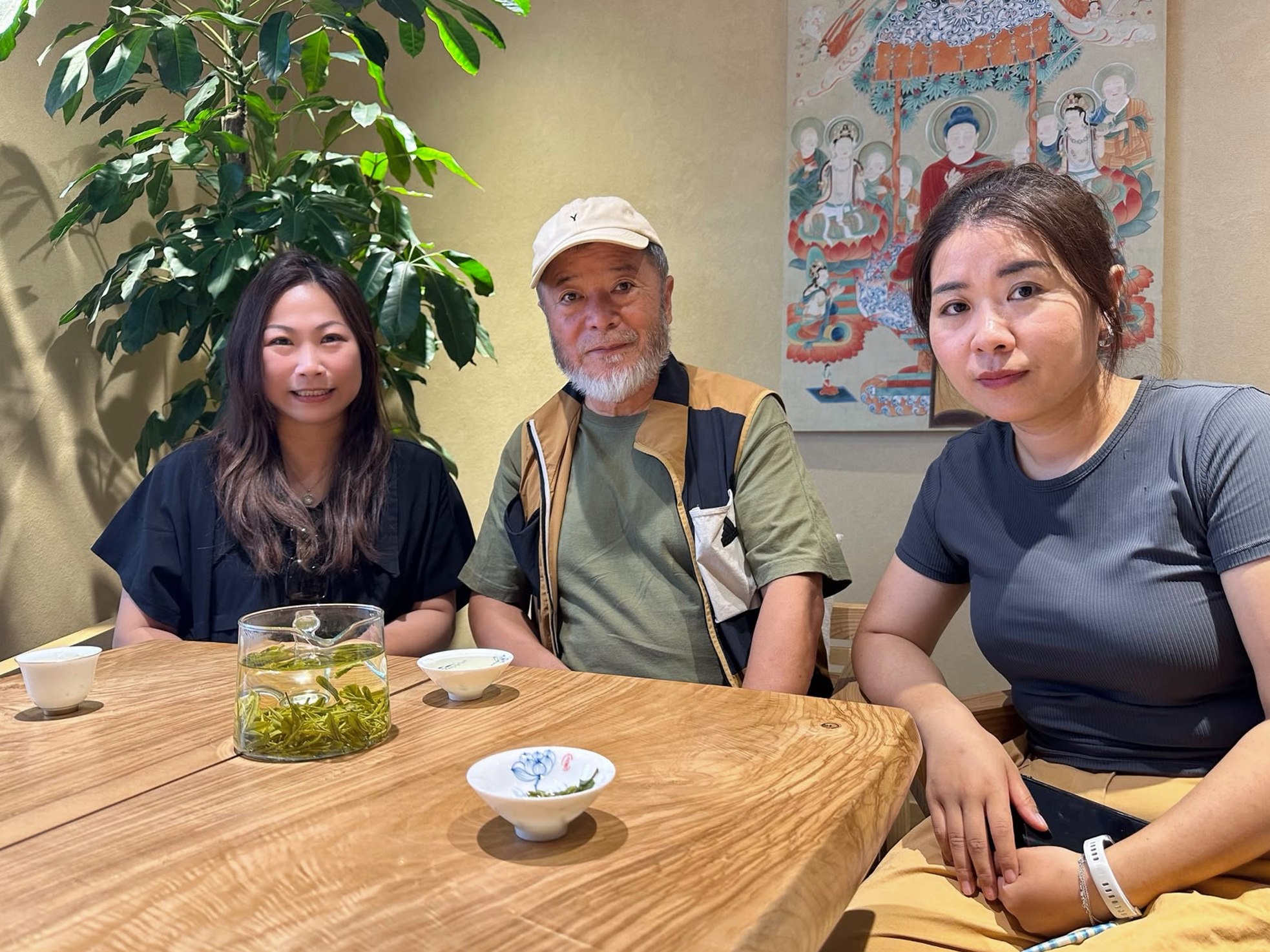
Niu Yusheng, born in 1963 in Yumen, Gansu, joined the Dunhuang Academy in 1982 and began mural copying in 1985, working in this field for nearly 40 years until his retirement in 2023. He is known as "the last generation of Dunhuang wall-facing copyists"—a designation that already hints at the fundamental transformation facing cultural transmission methods. His daughter, Niu Jia, born in Dunhuang in 1988, graduated from the University of the Arts London and the Prince's Foundation School of Traditional Arts in the UK. She is currently a doctoral candidate at Tsinghua University's Academy of Arts and Design and an assistant professor at the Beijing Institute of Fashion Technology, focusing on traditional pattern structure research and design innovation. The father, facing the millennia-old caves with his brush, and the daughter, facing modern design with digital tools—one "preserves," the other "creates"—together form a striking contrast of two pathways within cultural transmission.
This article takes the cultural practice of Niu Yusheng and Niu Jia as its point of departure to explore the transmission and transformation of Dunhuang's mural-copying tradition in the contemporary context, and to analyse the dialectical relationship between "preservation" and "creation" in cultural heritage.
"Wall-facing copying" refers to the practice of reproducing murals directly from the originals inside the caves. The particularity of this method lies in the fact that the copyist not only restores the colours and lines of the mural but also confronts the brushstrokes left by artisans a thousand years ago, seeking to understand the rhythm of their brushwork, the layering of their colours, and the logic of their composition. This is a form of knowledge acquired through bodily practice—the movement of the hand, the pressure of the brush, the mixing of pigments—none of which can be fully conveyed through digital images or written descriptions alone.
Niu Yusheng participated in the full-scale reproduction of Cave 220 at the Mogao Grottoes, copying important works such as the Preaching Scene, the Medicine Buddha Sutra Illustration, and the Manjushri Transformation. These tasks took years of dedicated effort, requiring intense concentration and endurance. Through long-term practice, he accumulated a "bodily memory" of the lines and colours of the murals—a memory that cannot be quantified yet forms the core of his artistic practice.
From the perspective of the sociology of knowledge, the "wall-facing copying" that Niu Yusheng engaged in is essentially a transmission of "embodied knowledge." The sociologist Michael Polanyi introduced the concept of "tacit knowledge"—knowledge that is difficult to articulate through language or writing but is transmitted through practice. The skills Niu Yusheng mastered through nearly 40 years of copying are a typical example of such tacit knowledge. The transmission of this knowledge relies on the "master-apprentice" system: within the Dunhuang Academy, new generations of copyists learn by following senior practitioners, observing their techniques, and practising repeatedly, gradually mastering the craft. This is a concrete manifestation of the Chinese cultural tradition of "oral instruction and heart-to-heart transmission."
However, with the advancement of digital technology, this mode of transmission is facing challenges. Today, younger copyists no longer need to work directly in front of the originals; they can copy from high-precision digital scans and then compare their work with the originals inside the caves. The label "the last generation of wall-facing copyists" given to Niu Yusheng carries a deeper implication: a practice of direct bodily engagement with history is being replaced by digitally mediated methods. This is not merely a technological shift but a fundamental transformation in the mode of knowledge production and transmission.
If the core of Niu Yusheng's practice lies in "preservation"—preserving the material life of the murals through copying—then the core of his daughter Niu Jia's practice lies in "creation"—giving Dunhuang culture new meaningful life through design. These two pathways form the dialectical relationship between "preservation" and "creation" in cultural transmission.
During her studies in the UK, Niu Jia created the interactive artwork Formless (《無相》), which allowed viewers to use sandpaper to rub and erase mural replicas, enabling them to personally experience the process of mural deterioration. The significance of this work lies in the fact that it does not simply replicate Dunhuang imagery but transforms the fact of "murals fading away" into an experience that the audience can undergo. In other words, Niu Jia does not merely imitate Dunhuang art superficially; she engages in deep reflection on its very state of existence.
Upon returning to China, Niu Jia did not choose to copy murals inside the caves but instead integrated Dunhuang art into modern design and digital innovation. Her work with the Dunhuang Costume Culture Research and Innovation Design Centre transforms the costume forms, colours, and patterns from murals and painted sculptures into modern design languages. This practice embodies a process of "cultural translation": extracting ancient cultural symbols from their original religious and historical contexts and re-embedding them into contemporary design and everyday life.
From the perspective of cultural studies, Niu Jia's path reflects the concept of the "invention of tradition." The cultural scholar Eric Hobsbawm pointed out that many practices regarded as "traditions" were actually created in relatively recent times and were endowed with continuity and legitimacy. Similarly, when Niu Jia digitises and designs Dunhuang costume culture, she is not replicating tradition but "reinventing" it—presenting traditional elements in new forms and new media, giving them new vitality in the contemporary context.
The father's "preservation" and the daughter's "creation," though seemingly divergent, both point in the same direction: ensuring the continuation of Dunhuang culture. Without the father's "preservation," the daughter's "creation" would lack a foundation; without the daughter's "creation," the father's "preservation" would remain a static, museumised conservation. The two are mutually dependent, together constituting a complete picture of cultural transmission.
One noteworthy aspect of Niu Jia's experience is her transnational educational background and cultural identity. During her studies in London, she not only gained an international perspective but also re-examined her own cultural identity. She said: "No matter where I am, when I look back, I see Dunhuang." This phrase condenses a common experience among non-Western cultural elites—the "diaspora-return" trajectory: deepening self-understanding through dialogue with others, and strengthening one's own foundations by absorbing external resources.
From the perspective of postcolonial theory, this experience is closely related to the concept of "cultural return." In the context of globalisation, many intellectuals from non-Western cultures undergo a trajectory of "departure—study—return": departure to gain new perspectives, study to acquire new tools, and return to apply what they have learned to the reconstruction of their own culture. Niu Jia's experience is not an isolated case but a common path for contemporary Chinese cultural inheritors—acquiring intercultural competence through international education and then applying that competence to the innovation of their native culture.
It is worth noting that Niu Jia's "return" does not mean returning to her father's way of working; rather, she participates in the continuation of Dunhuang culture in a distinctly different manner. This reflects the complexity of cultural identity in the globalised era: it is not a static belonging but a process continually reconstructed through dialogue and practice. Niu Jia both identifies with her Dunhuang cultural roots and transcends geographical limitations, transforming them into a design language with universal appeal. This model of "global vision, local practice" is a key feature of contemporary cultural transmission.
Niu Jia's practice of digitising Dunhuang costume culture can be understood within the context of the "digital humanities"—an interdisciplinary field that uses digital technology to study and disseminate humanistic knowledge, with a core concern for how new technologies can bring new life to ancient cultural heritage.
In the traditional model of cultural relic conservation, murals are regarded as precious objects that need to be isolated and protected, with public access strictly limited. The emergence of digital technology has changed the limitations of this "isolationist protection." High-precision scanning, 3D modelling, virtual reality, and other technologies allow the details of murals to be magnified, reproduced, and disseminated, thereby enabling more people to access these cultural treasures.
Niu Jia's practice goes a step further: she not only digitises Dunhuang costume culture but also transforms it into a resource applicable to modern design. The significance of this "revitalisation" lies in its breaking down of the barriers between cultural heritage and everyday life. When Dunhuang patterns appear on school uniforms, carpets, or fashion designs, they are no longer objects to be admired in museums but become part of people's daily experience. This shift from "display" to "use" reflects a movement in cultural transmission from "static preservation" to "living transmission."
Of course, digitisation and revitalisation also bring new issues. When ancient cultural symbols are extracted, recombined, and re-embedded into contemporary contexts, can their original religious and historical meanings be diluted or distorted? This is a question worth continuous attention. On the other hand, any cultural tradition must undergo such "recontextualisation" to survive—to be given new meanings in different eras and different contexts. Niu Jia's practice embodies this dynamic nature of cultural continuity.
Returning to the question posed at the beginning of this article: how can the tradition of Dunhuang mural copying continue in the present day? The story of Niu Yusheng and Niu Jia offers one possible answer.
Niu Yusheng's nearly 40 years of "wall-facing copying" safeguarded the material life of Dunhuang's murals—with his brush and pigments, he preserved irreproducible and fading murals, extending their existence. Niu Jia's digital design and cultural translation give Dunhuang culture new meaningful life—with design and digital tools, she transforms a thousand-year-old civilisation into contemporary language, allowing it to resonate with younger generations.
The practice of these two generations demonstrates that cultural transmission is never a unidirectional replication but a dialectical movement of "preservation" and "creation." Without "preservation," tradition loses its foundation; without "creation," tradition loses its vitality. The two complement each other, together forming the complete mechanism of cultural continuity.
From a broader perspective, the story of Niu Yusheng and Niu Jia is a microcosm of the contemporary transmission of Chinese culture. The secret to Chinese culture's endurance for millennia lies in its ability to be reinterpreted and repractised in different ways in different eras. As sociologist Csikszentmihalyi's "systems model of creativity" suggests, creativity is never an isolated act by an individual but the result of interaction between the "individual, domain, and field." Niu Yusheng, working within the Dunhuang Academy system, cultivates traditional skills (the domain); Niu Jia, operating in international academia and design, expands the boundaries of innovation (the field); together, they drive the creative transformation of Dunhuang culture in the contemporary era (individual creativity).
Passing the torch (xinhuo xiangchuan, 薪火相傳) is not about handing down the flame unchanged, but about allowing each generation to add its own fuel, so that the fire burns in different ways in different times. The story of Niu Yusheng and Niu Jia is a vivid illustration of this proposition.
1.Csikszentmihalyi, M. (1996). Creativity: Flow and the Psychology of Discovery and Invention. New York: HarperCollins.
2.Hobsbawm, E., & Ranger, T. (Eds.). (1983). The Invention of Tradition. Cambridge: Cambridge University Press.
3.Polanyi, M. (1966). The Tacit Dimension. London: Routledge & Kegan Paul.
4.Niu Yusheng & Niu Jia (2025). One Life, One Dunhuang. Xi'an: Shaanxi Normal University Press.
5.Dunhuang Academy (Ed.). (2020). Techniques of Dunhuang Mural Copying. Lanzhou: Gansu People's Art Publishing House.
All articles/videos are prohibited from reproducing without the permission of the copyright holder.
SHARE THIS




 Thank you for your like.
You’ve liked this article. Please browse more articles you may like!
people have liked this article/video
Thank you for your like.
You’ve liked this article. Please browse more articles you may like!
people have liked this article/video