CAO Cao, His Sons, and the Jian'an Spirit
CHEN Lin (陳琳, ? - 217) excelled at writing denunciatory proclamations, which were used to condemn enemies and declare their crimes. He once drafted a proclamation for YUAN Shao (袁紹, ? - 202) denouncing CAO Cao (曹操, 155-220). Its language was sharp and cutting, and it attacked CAO Cao so mercilessly that it left him thoroughly eviscerated. Later, when CHEN Lin switched his allegiance to CAO Cao, CAO Cao said to him, "It would have been enough to curse me. Why did you also have to curse my ancestors?" CHEN Lin hurriedly apologized. Since CAO Cao valued talent, he let the matter drop.
Promoted by CAO Cao, a Poetic Style Both Stirring and Mournful
In the last years of the Eastern Han dynasty (東漢, 25 - 220), CAO Cao not only donned armor and rode into battle, but also loved to hold banquets where poems were exchanged over wine. It was thanks to his active promotion that the flourishing literary scene of the time took shape. When people mention Jian'an literature, the first thing that comes to mind is the "Jian'an spirit (建安風骨)." The term broadly refers to the poetic style of the literati centered on CAO Cao and his two sons, CAO Pi (187 - 226) and CAO Zhi (192 - 232), along with the Seven Masters of Jian'an (建安七子). Using the newly emerging five-character form (五言) and drawing on folk songs, they reflected reality and expressed their aspirations in verse that was both stirring and mournful.
The emergence of this literary style was closely tied to the circumstances of the times. In "Shi Xu" of “The Literary Mind and the Carving of Dragons (《文心雕龍·時序》), it is said: This was truly because the long years of warfare had left the common people displaced, public morals and culture in decline, and hearts weighed down with sorrow. The literati carried deep feelings within them and were able to pour them out freely in writing, so their works were stirring and impassioned, full of power.” (良由世積亂離,風衰俗怨,並志深而筆長,故梗概而多氣也。)
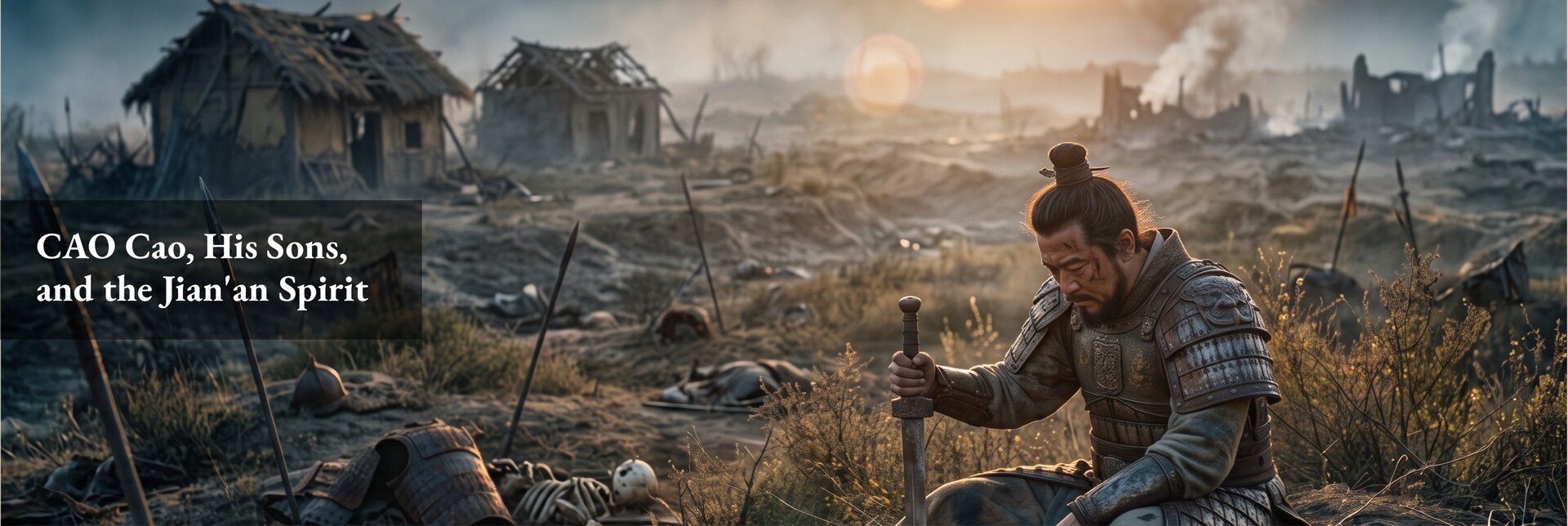
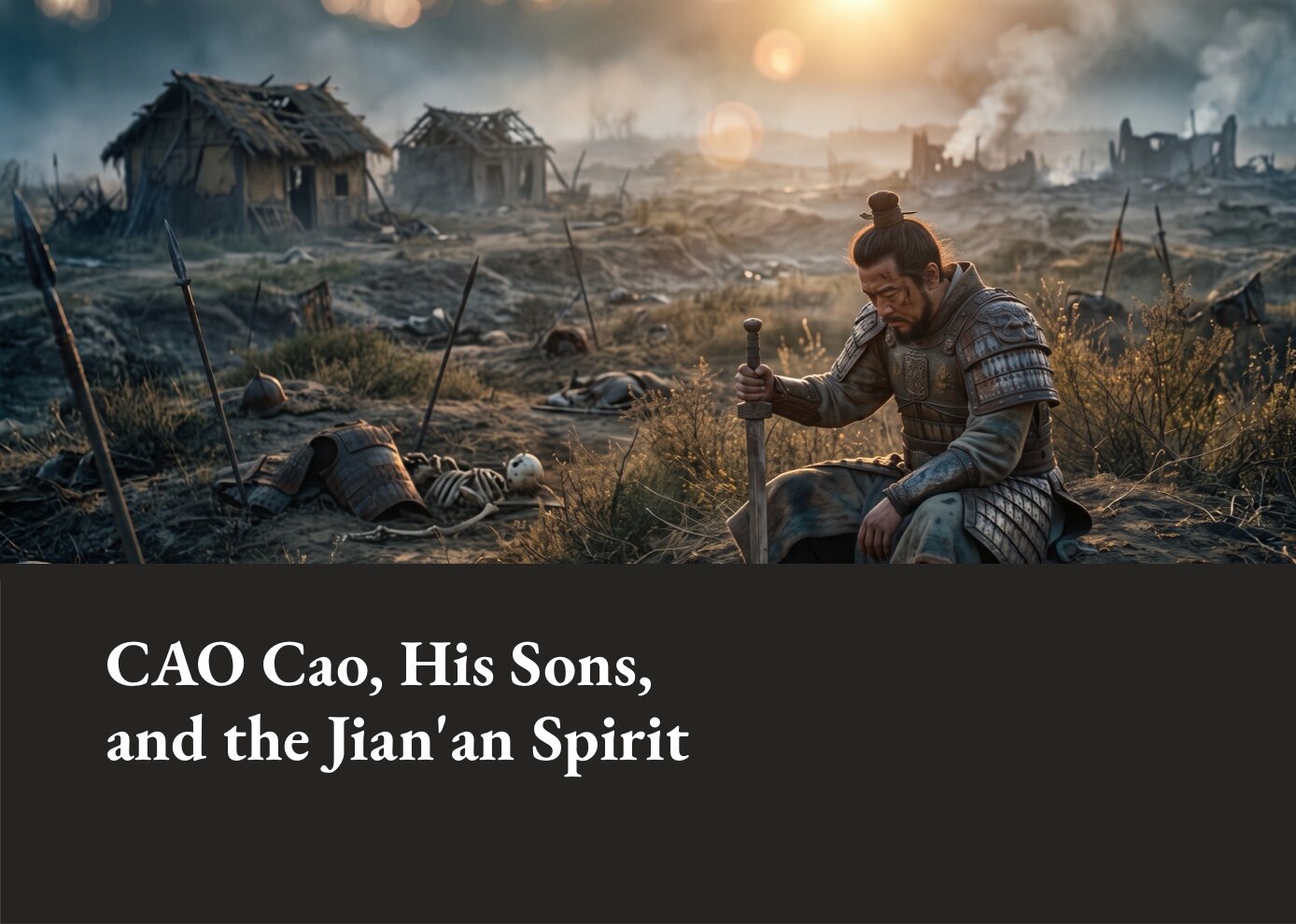
The Jian'an period (建安年間, 196 – 219) was an era of political turmoil. The imperial court was corrupt, while provincial governors carved out their own domains and warred endlessly with one another. CAO Cao's lines, " White bones lay exposed in the wilds, and for a thousand li not a rooster's crow could be heard. (白骨露於野,千里無雞鳴)," offer the finest portrait of that age, when no sign of human habitation could be found for a thousand li around. Most of the Jian'an poets had lived through lives of displacement and wandering, hearing and witnessing scene after scene of living horror. And so, in vigorous yet elegant language and in a mournful, impassioned tone, they portrayed a war-torn land filled with the cries of the suffering, or sang out their ideal of a unified realm. Their sentiments ran deep, and their writing was stirring and spirited, full of momentum.
A True Record of the Late Han, Exuding the Spirit of the Age
Most of the poets of the Jian'an period captured the pulse of their times in their work. They were neither affected nor given to embellishment, and their poems, rising and falling with sorrow and lament, exude an air of passionate grandeur and desolate pathos. In his poem "Elegy of the Wilderness" (《蒿里行》), CAO Cao describes the disasters that warlord rivalry and warfare brought upon society and its people:
The righteous armies east of Hangu Pass rose up to punish the treacherous and rebellious officials.
關東有義士,興兵討群凶。
They had agreed to muster at Mengjin, single-mindedly set on restoring the Han house.
初期會盟津,乃心在咸陽。
But once the troops had assembled, their hearts were not united; each side watched the others and hesitated to advance.
軍合力不齊,躊躇而雁行。
Power and profit set men to fighting over them, and before long the lords were slaughtering one another.
勢利使人爭,嗣還自相戕。
YUAN Shu in Huainan openly proclaimed himself emperor, while YUAN Shao in the north secretly carved a jade seal, nursing treasonous designs.
淮南弟稱號,刻璽於北方。
Soldiers wore their armor year after year until it was infested with lice, and tens of thousands upon thousands of common people met their deaths.
鎧甲生蟣虱,萬姓以死亡。
White bones lay exposed in the wilds, and for a thousand li not a rooster's crow could be heard.
白骨露於野,千里無雞鳴。
Only one in a hundred of the people survived; to think of such devastation tears at one's very heart.
生民百遺一,念之斷人腸。
The Ming dynasty (明朝, 1368 - 1644) scholar ZHONG Xing (鍾惺, 1574 - 1624) praised this poem as "a true record of the late Han, a genuine poetic history (漢末實錄,真詩史也)." The poem depicts the generals who marched against DONG Zhuo (董卓, 139 - 192), only to scramble for power and profit. Year after year of warfare left the soldiers no chance to take off their armor, and countless men were killed or wounded. The common people suffered terribly in the ravages of war; the land was sparsely populated and strewn with white bones, a sight that is truly shocking.
In the first of his "Seven Sorrows (《七哀詩》)" poems, the poet WANG Can (王粲, 177 - 217) describes the harrowing scenes he witnessed on his journey from Chang'an (長安) to Jingzhou (荊州), where he fled to escape the turmoil:
On the road I saw a starving woman who set her baby down in the grass and abandoned it.
路有饑婦人,抱子棄草間,
Hearing the child's cries, she looked back, yet wiping away her tears, she still would not return.
顧聞號泣聲,揮涕獨不顧。
She signed: I don't even know where I myself will die—how could I possibly keep both mother and child alive?
未知身死處,何能兩相完﹖
I could only spur my horse onward and leave, unable to bear hearing any more of such grief-stricken words.
驅馬棄之去,不忍聽此言。
Heading south, I climbed the heights of Bailing and turned to gaze far back at the old capital, Chang'an.
南登霸陵岸,回首望長安。
Only then did I come to deeply understand the longing for an age of peace in the poem " Underground spring," and I couldn't help but heave long sighs, my heart aching with sorrow.
悟彼下泉人,喟然傷心肝。
The poem describes a mother who abandons her child in the wild grass and does not look back, even when she hears the child crying. When passersby reproach her, she replies, " I don't even know where I myself will die—how could I possibly keep both mother and child alive?" The poet is heartbroken, yet there is nothing he can do to help and he can only lament his powerlessness. These poems reflect the social reality of a time of war and chaos and the terrible suffering of the people, and every line is full of the author's sorrow over the times and the state of the world.
Expressing the Aspirations, Longing to Achieve Great Deeds=
Faced with turbulent times and witnessing the suffering of the people, the literati of the Jian'an period longed to achieve great deeds and fulfill their ambitions, which is also one of the essential qualities of the Jian'an spirit. For example, CAO Cao expressed this political ideal in his poem "Facing the Wine (《對酒》)" :
Raising a song over fine wine, I long for that age of peace, when officials would not come knocking to harass the common people.
對酒歌,太平時,吏不呼門。
The ruler is wise and enlightened, and the ministers who assist him are all loyal and good.
王者賢且明,宰相股肱皆忠良。
Everyone values courtesy and deference, and there are no quarrels or lawsuits among the people.
咸禮讓,民無所爭訟。
After three years of farming, they can store enough grain to last nine years, and the granaries are filled to overflowing.
三年耕有九年儲,倉谷滿盈。
The poem expresses the ideal society that CAO Cao longed for. In this society, the ruler is wise and his ministers loyal; everyone observes proper etiquette and lawsuits do not arise; officials do not come knocking at doors to demand rent or collect debts; those in power reward and punish fairly and care for the people; and everyone has enough food and clothing and lives out their natural lifespan.
CAO Zhi's poetry likewise expresses this spirit of active ambition. In his early years, he had already set himself the lofty goal of "Worrying over the affairs of state while forgetting one's own family, and sacrificing one's life to rescue the nation from peril (憂國忘家,捐軀濟難)," and he also followed his father on campaigns in every direction. In his "The White Steed (《白馬篇》)," he wrote:
Having thrown myself between blades and spears, how could I spare my own life?
棄身鋒刃端,性命安可懷?
If I cannot even look after my parents, how could I speak of wife and children?
父母且不顧,何言子與妻﹖
With my name entered in the roll of warriors, my heart can no longer dwell on private or family concerns.
父母且不顧,何言子與妻﹖
With my name entered in the roll of warriors, my heart can no longer dwell on private or family concerns.
名編壯士籍,不得中顧私。
I give up my life to rush to the country's hour of peril, and I regard death as no more than returning home.
捐軀赴國難,視死忽如歸。
In this poem, CAO Zhi portrays a heroic young warrior on a white steed—highly skilled in martial arts, loyal to his country, and unafraid of death—through whom he expresses his own ideals and aspirations.
CAO Cao and his sons were passionate about literature and did not use their political authority to stifle writers' creativity. As a result, the writers of the Jian'an period were free to express their own feelings and ambitions in their work, which radiates a strong sense of its era.
Footnote
1. 指東漢獻帝建安年間作家孔融、陳琳、王粲、徐幹、阮瑀、應瑒與劉楨等七人。
2.《古詩歸》卷七。
3.《求自試表》,見《樂府詩集》第二十七卷《相和歌辭二》。
All articles/videos are prohibited from reproducing without the permission of the copyright holder.
SHARE THIS




 Thank you for your like.
You’ve liked this article. Please browse more articles you may like!
people have liked this article/video
Thank you for your like.
You’ve liked this article. Please browse more articles you may like!
people have liked this article/video
Welcome to leave a message:
Please Sign In/Sign Up as a member and leave a message