Cold Dew, Warm Tea
In the old city, the sunset is beautiful.
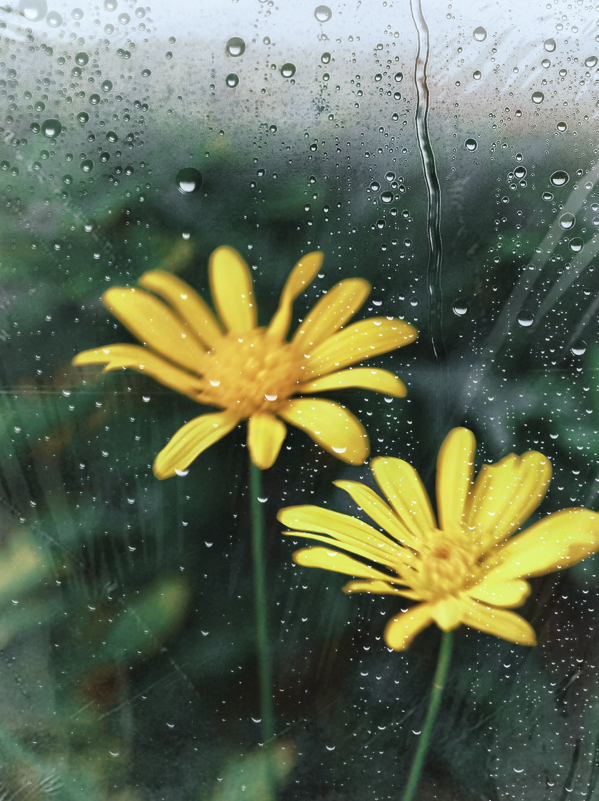
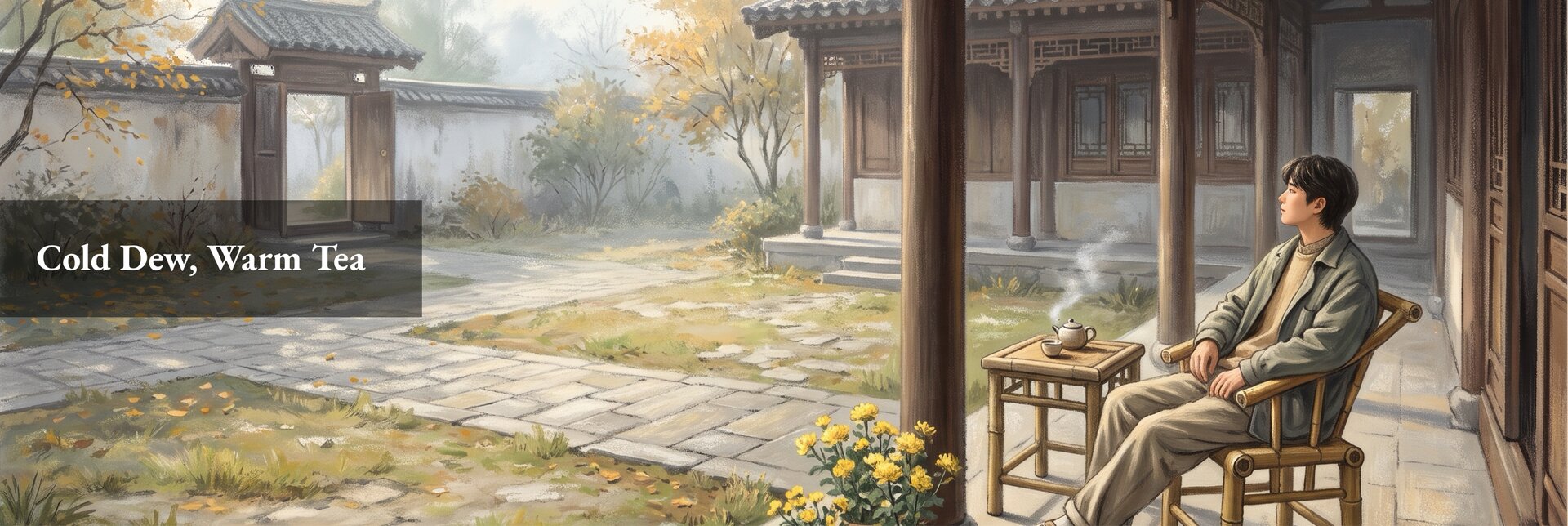
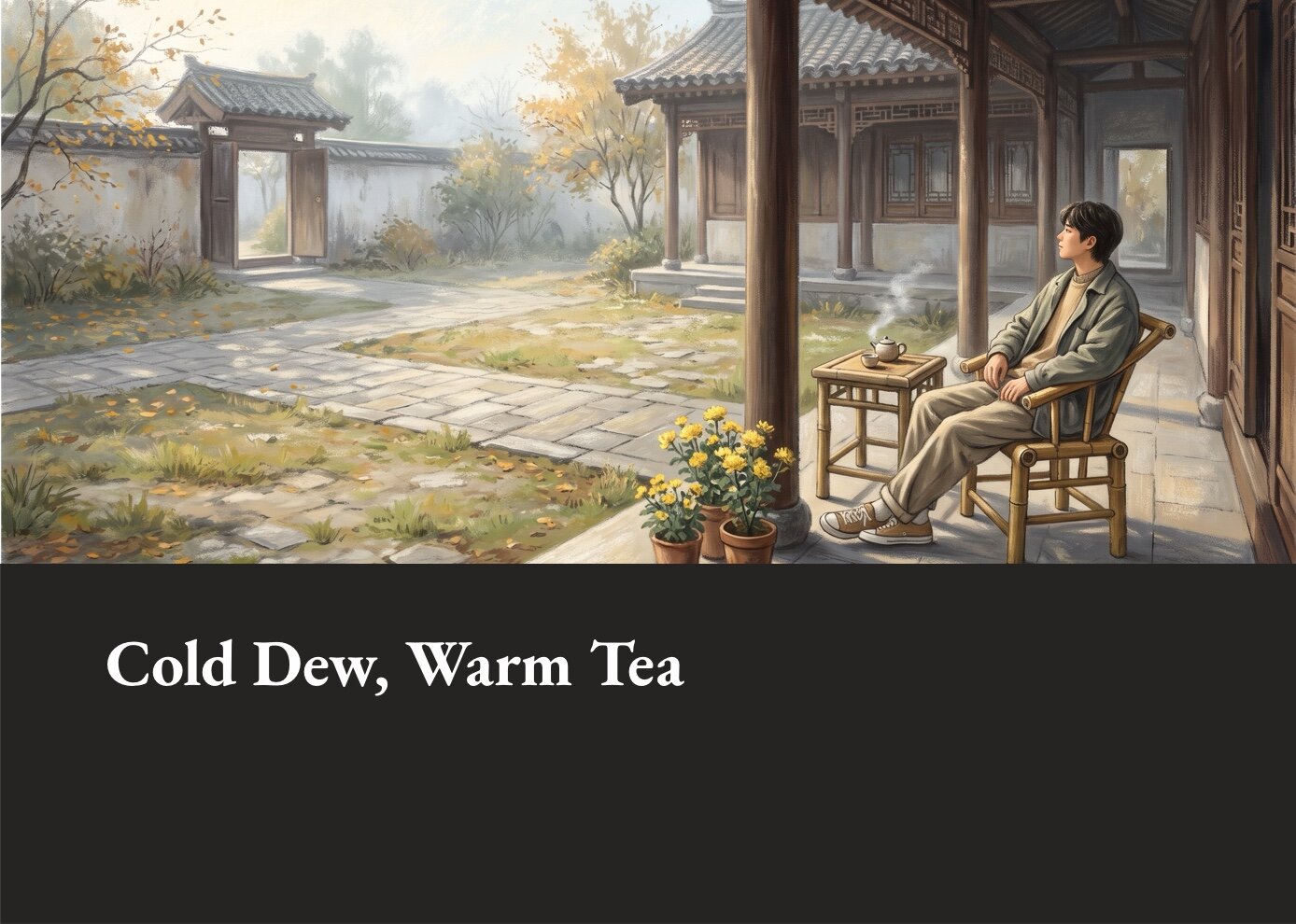
Along the foot of the wall stands a row of clay pots, all planted with chrysanthemums. When Cold Dew arrives, bamboo chairs are carried out onto the veranda, tea is brewed, and everyone waits for the chrysanthemums to bloom slowly. Someone sits in a bamboo chair doing nothing at all, just watching the flowers. Yuan Zhen (元稹, 779-813) once wrote, "At the time of Cold Dew, autumn has deepened; and when you look out in the early morning, the chrysanthemums are slowly taking on a golden hue (寒露驚秋晚,朝看菊漸黃)." No hurry, no rush: the tea stays warm, the flowers open, and the day simply arrives.
Autumn dew is at its clearest. At night it gathers on the grass and trees, and by daybreak it lies in a distinct, shining layer, only to vanish once the sun comes out.
You can see it, but you cannot keep it. That is perhaps what "dew" means.
The Double Ninth Festival (重陽節) is drawing near again. In the north, people climb heights; in the south, they admire chrysanthemums.
When the weather turns cool, everyone feels the same. Bai Juyi (白居易, 772-864) was also a tea lover. He once brewed a fine tea and invited the Chan master Taoguang (韬光禅师); when the master did not come, Bai took tea and snacks and climbed the mountain to find him. "Picking chrysanthemums beneath the eastern hedge, I lift my head without a thought, and the southern mountains come into view (採菊東籬下,悠然見南山)." The tea gathering at Southern Mountain arrives right on schedule.
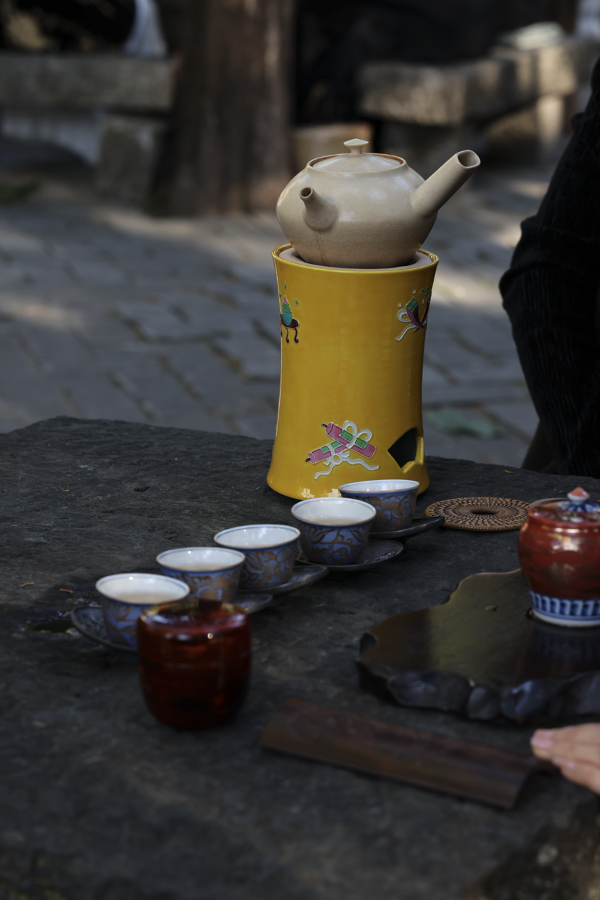
Yesterday I left two teas on the table: Tie Guan Yin (鐵觀音) and Da Hong Pao (大紅袍).
Tie Guan Yin is picked around Cold Dew, and is known as autumn tea. When steeped, its fragrance is lofty and delicate, with an orchid undertone and a faint sweetness like osmanthus. The liquor is golden. On the palate, the water feels soft and silky, with a gentle sweetness. After seven or eight infusions, the scent still lingers at the bottom of the cup. What you drink in Tie Guan Yin is the fragrance of autumn.
Tie Guan Yin comes from Anxi (安溪). One account says that Guanyin (觀音菩薩) appeared to Wei Yin (魏蔭, 1703-1775) in a dream, and he found a tea plant in a crack in the rocks and planted it in an iron cauldron, hence the name " Tie Guan Yin " — "Iron Guanyin." Which version is true, no one can say.
After the Tie Guan Yin, we switched to Da Hong Pao.
The second round.
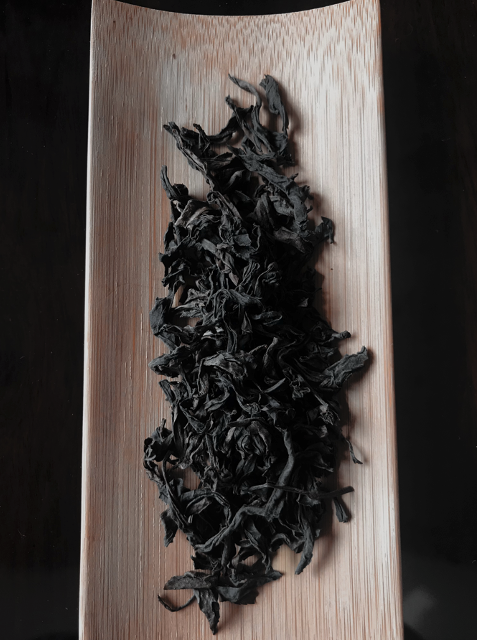
Da Hong Pao
Warm the cup, then swirl to release the aroma. The fragrance came in waves, each higher than the last — the tea with a rich, robust character as solid as rock, yet carrying a delicate floral and fruity fragrance (岩骨花香).
Old Wu, sitting nearby, said, " Leaf rejuvenation and water movement (還陽走水)." I didn't understand. He added, "Its wilt." Someone next to him chimed in, "It means the tea leaves wilt and then perk up, perk up and then wilt, back and forth." Old Wu nodded. "Once they've been through enough of that, the fragrance comes out."
I lifted the cup. The fragrance was in my nose, the warmth in my belly. All that wilting and perking up from before seemed to be contained in this one sip.
Just then, a bookmark-style name card was passed over. On it was the origin of Da Hong Pao: in ancient times, a scholar traveling to the capital to sit for the imperial examinations fell ill while passing through Mount Wuyi (武夷山). The abbot of Tianxin Temple (天心寺) saved him with tea from the cliff face at Nine Dragon Nest (九龍窠). The scholar later placed first in the examinations and, to repay the kindness, draped the red robe the emperor had bestowed upon him over the tea bushes. That is how the name Da Hong Pao, "Big Red Robe," came to spread.
When the card was turned over, the back was blank.
The Da Hong Pao was full-bodied, like a stone warmed by the sun, its warmth traveling from the throat down into the belly.
Night in the old town, a teahouse.
The young man from the little shop next door burst in carrying a palm-sized bottle of mineral water. He held up that little bottle and froze in the middle of the table. Every piece of tea ware on it was bigger than the bottle in his hand. The little bottle stood there, thin and small, as if it had come through the wrong door.
He didn't know where to put it either, so he just kept holding it up. Someone pointed to the spot beside the chrysanthemum vase, and only then did he set it down.
No one knew who laughed first, but then the whole room laughed. Someone else placed the little bottle beside the firework chrysanthemum vase and said, "Fine, let it be a mirror for the flowers."
The little bottle reflected the chrysanthemums, and the chrysanthemums reflected the little bottle. The whole room looked on and laughed again.
The Tieguanyin is clear, the Da Hong Pao is rich, and that little pot of water has gone cold. It has sat there beside the chrysanthemum vase all along, and everyone who glances at it lets out a laugh.
Today the teapot is warm, the water is low, and a roomful of laughter is warmer than anything. So warm that everyone forgot it is already Cold Dew outside.
Chrysanthemum wine, mixed with the warmth of Cold Dew tea.
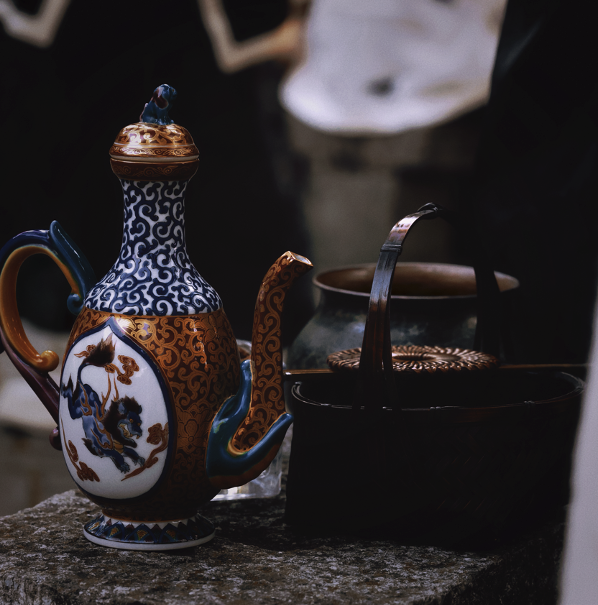
Half a cup to the autumn light, half a cup to yourself.
Not entirely drunk, not entirely sober.
Not everyone has left, and the tea has not entirely gone cold.
That's just fine.
All articles/videos are prohibited from reproducing without the permission of the copyright holder.
SHARE THIS


 Thank you for your like.
You’ve liked this article. Please browse more articles you may like!
people have liked this article/video
Welcome to leave a message:
Please Sign In/Sign Up as a member and leave a message