

TAN Sitong: The Confucian Swordsman
In my youth, I read LI Ao's (李敖, 1935-2018) "History and Portraits (《歷史與人像》)," which contained an essay titled "An Textual Study on 'Two Kunlun' (〈「兩崑崙」考〉)"1, and upon careful reflection, I found myself in considerable disagreement with it.
"Kunlun" appears in the poem "Inscription on the Prison Wall (《獄中題壁》)," the death-verse written by TAN Sitong (譚嗣同, 1865-1898), one of the "Six Gentlemen of the 1898 Reform Movement (戊戌六君子)":
Recalling how ZHANG Jian persecuted in his day,
Looking for households' doors to seek shelter and refuge;
I wish to be like DU Gen when he suffered a caning,
Enduring the threat of death to wait for the revival.
(望門投止思張儉,忍死須臾待杜根。)
Facing the executioner's blade,
I laugh heartily up at the sky;
Whether departing to escape calamity or staying behind to sacrifice,
The loyalty and courage of us are as towering and lofty as the Kunlun Mountains.
(我自橫刀向天笑,去留肝膽兩崑崙。)2
In those years, reading the history of the 1898 Reform Movement, I was deeply moved with pity for TAN Sitong's willingness to face execution; and as for his talent and his Confucian spirit of "Establishing one’s mind through benevolence, and achieving righteousness through one’s being (以仁立身,以身成義)," neither KANG Youwei (康有為, 1858-1927) nor LIANG Qichao (梁啟超, 1873-1929) could ever hope to match him.
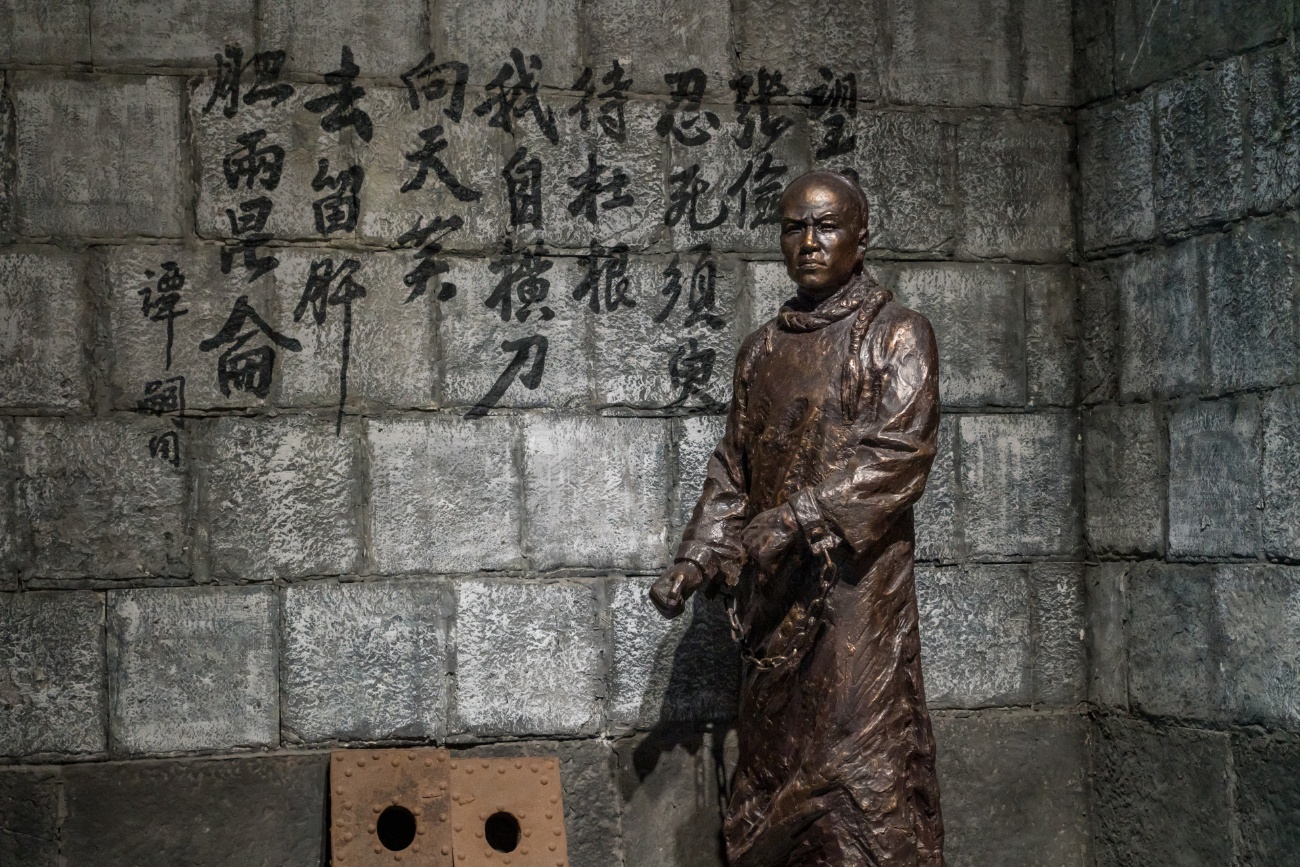
In the twenty-fourth year of the Guangxu reign of the Qing dynasty (1898), TAN Sitong, then 33 years old, was arrested and imprisoned by Empress Dowager Cixi (慈禧太后, 1835-1908). The Reform Movement lasted only 103 days before the "Six Gentlemen"—KANG Guangren (康廣仁, 1867-1898), YANG Shenxiu (楊深秀, 1849-1898), LIN Xu (林旭, 1875-1898), YANG Rui (楊銳, 1855-1898), LIU Guangdi (1861-1898), and TAN Sitong—were executed without trial. KANG Youwei and LIANG Qichao, meanwhile, had already fled.
The death-verse left by TAN Sitong in prison contains the phrase "兩昆侖," which LIANG Qichao explained as follows: "One refers to Nanhai (南海, that is, KANG Youwei, since KANG was a native of Nanhai, Guangdong), and the other is the swordsman 'Big Blade' WANG Wu, referred to as WANG Zhengyi (王正誼 also known as “大刀”王五, 1844-1900) in the 'Biography of WU Tieqiao (《吳鐵樵傳》)' written by TAN Sitong. Wang WU was a Da Xia (大俠)3 of the Youyan region (幽燕)4, who made his living as a guard; his sphere of influence extended north to Shanhai Pass (山海關) and south to Qingjiangpu (清江浦), and throughout his life he devoted himself to suppressing the strong and aiding the weak. As a youth, TAN Sitong once studied swordsmanship under him, and the two held each other to standards of moral principle and duty. During the reform movement upheaval of 1898, the man from Liuyang was involved in the conspiracy to seize the palace gate and rescue the Emperor, but before the plan could be carried out, he was arrested; WANG Wu, however, never abandoned this resolve. In the eighth month of the year of Gengzi (1900), he had made certain plans, but was suddenly killed by the Boxers, his ambitions ground to dust along with his death. Alas! WANG Wu was truly a man among men, worthy of the man from Liuyang!5 This is LIANG Qichao's explanation of the term "兩昆侖," the earliest such interpretation, and one cited by many later writers. XIANG Kairan's (向愷然, also known as 平江不肖生, 1890-1957) "Biographies of Modern Heroes of Chivalry (《近代俠義英雄傳》)" opens its first chapter by citing this account.6 Many sources record the friendship between TAN Sitong and WANG Wu. It is said that when TAN was ten years old and studying in Beijing, he already followed WANG Wu to learn martial arts,7 and Some scholars believe that he once composed the "Poem Presented to a Dancer (《贈舞人詩》)" for WANG Wu.8
TAN Sitong and WANG WU were not merely in an ordinary teacher-student relationship through martial arts study, but shared many common pursuits in their thinking. After the 1898 coup, when Empress Dowager Cixi confined Emperor Guangxu (光緒帝, 1871-1908) to Yingtai (瀛臺), TAN Sitong sought out WANG Wu to discuss forcibly entering the palace by force to rescue the Emperor, but this proved impossible to carry out. WANG Wu urged TAN Sitong to flee, offering to personally escort him, but TAN Sitong refused. By that time TAN had already resolved to die, and was eventually captured. Before his execution, WANG Wu planned to storm the execution ground to rescue him, but the guard there was too heavily fortified, and he was forced to abandon the plan. After TAN Sitong was executed, many feared implication and dared not approach, but WANG Wu resolutely came forward to collect his body.9
WANG Wu was skilled in wielding the Dadao (大刀, big sword), but according to tradition, what he taught TAN Sitong was swordsmanship — WANG Wu was in fact proficient in both Dao (刀) and sword. After reviewing the various interpretations of "兩昆侖" from different schools of thought, LI Ao concludes that TAO Juyin's (陶菊隱, 1898-1989) account10 "Seems the most fitting and appropriate":
In October of 1940, Zhonghua Book Company published a work by TAO Juyin titled "New Forest of Words (《新語林》)". In the fourteenth essay of this book, "As lofty as Kunlun Mountain (〈去留肝膽兩崑崙〉)," he narrates, in the style of fiction, a moving story. In brief, when XU Shichang (徐世昌, 1855-1939) served as President of the Beiyang government, one day he hosted a banquet at Huairen Hall in Beiping (北平, Today’s Beijing). Among the guests was a man surnamed YI (易), who, upon leaving after the meal, slipped on the floor and broke his left arm. The doctor summoned was named HU Zhiting (胡致廷), commonly called HU Qi (胡七), nicknamed "Long-Armed Ape (通臂猿)," a native of Taiyuan, Shanxi (山西太原), who at the time taught boxing at the police bureau and treated sprains and fractures as a side occupation. One day, moved by a sudden impulse, HU Qi, in between treating the patient, told Mr. Yi that he had known TAN Sitong, saying: "When Mr. Tan lived at the Liuyang Guesthouse (瀏陽會館) in North Banjie Hutong (北半截胡同), 'Single Blade' WANG Wu and I met with him every day without fail... The two of us together taught him martial arts." He also said that they belonged to a group of "sworn brothers (兄弟, the person who joined the secret organization)" who were determined to act with chivalry and righteousness, to right all injustices under heaven. At the time, they sought to find someone of learning, courage, and standing to serve as their "elder brother," and by this standard they settled upon TAN Sitong; TAN Sitong, in turn, held them in high regard. When the coup failed, HU Qi and WANG Wu went to the Liuyang Guesthouse to urge TAN Sitong to flee, but TAN Sitong wished to die for his principles, and despite their earnest pleading, he would not be persuaded. Soon after, officers swarmed in to make the arrest, and HU Qi and WANG Wu were forced to leap over the wall and flee. Later, the two men plotted to storm the execution ground, but the guard was too strict, leaving them no way to act.
LI Ao states, "HU Qi died in 1929, at the age of seventy-four. He claimed that the martial arts he and WANG Wu practiced both belonged to the 'Kunlun School (昆侖派)' — this may well be the true meaning behind the phrase '去留肝膽兩崑崙.' The interpretation of 'Two Kunlun (兩崑崙)' seems best matched and most fitting when understood through TAO Juyin's account."11
This interpretation is rather far-fetched and does not accord with the spirit of the poem as a whole. To explain "Two Kunlun" as referring to the "Kunlun School" is nothing short of a joke.
Amid the tense atmosphere of impending crisis, Liang Qichao once met with Tan Sitong, who told him: "If there is no one who flees into exile, there can be no one to plan for the future task of restoring the nation and renewing it; if there is no one who dies boldly and without regret, there can be no one to repay the sage-like sovereign's grace. Now whether Kang Youwei lives or dies remains uncertain—just as in ancient times there were CHENG Ying and GONGSUN Chujiu12, and in Japan there were the monk Gessho and Saigō Takamori, so too shall these two duties be divided between you and me (不有行者,無以圖將來;不有死者,無以酬聖主。今南海之生死未可卜,程嬰杵臼,月照西鄉,吾與足下分任之)."13
"Fugitive (行者)" refers to LIANG Qichao, and "Martyr (死者)" refers to TAN Sitong. Viewed this way, does "Two Kunlun (兩崑崙)" refer to TAN and LIANG?
In my view, "those who flee" does not refer solely to KANG, LIANG, and WANG Wu and others; nor does "those who die" refer solely to TAN Sitong alone. As for "Kunlun," it refers to a person of towering greatness—just as some scholars call QIAN Zhongshu (錢鐘書, 1910-1998) the "The Kunlun of Cultural World (文化崑崙)"14, taking the same meaning.
Therefore, "Two Kunlun" does not mean "two people (兩人)." Semantically, besides the numerical sense of "two (兩)" as in "two items (兩個)," the character can also be interpreted as "並 (together or side by side)," as in the line "The outer horses on both sides gallop without deviation (兩驂不猗)" from the "the Book of Songs, Minor odes of the kingdom, Che Gong meaning (《詩經·小雅·車攻》)". Viewed in this light, "Two Kunlun" means "the mountain ranges of Kunlun Mountain standing together (並崑崙)."
On this basis, "去留" can be interpreted such that "行者" refers to "Fugitive" and "死者" to " Martyr"—yet whether "行" or "死," both are "the ranges of Kunlun," both are standing "together." Given this, other interpretations of "Two Kunlun" may now be set aside.

Additional Remarks
"The Benevolence (《仁學》) "15 is a short work written by TAM Sitong two years before his martyrdom. This book blends the scholarship of Confucianism, Buddhism, Daoism, Mohism, and other schools, together with newly introduced Western theories, and has been described by some scholars as "rather sprawling and disorganized (相當的支蔓蕪雜)"16.
To study TAN Sitong's thought, one must understand what "benevolence (仁)" means to him. He believed that benevolence is a kind of moral value—the very essence of Confucian ethical thought, and the confluence of all other moral concepts.17 Radiating outward from this confluence or "center (中心)," almost all the doctrines of the various schools of thought are encompassed within it.
However, in terms of practical application, TAN Sitong's composed acceptance of martyrdom remained fundamentally in the spirit of Confucianism. "The Analects, Duke Ling of Wey" (《論語·衛靈公》) states: "There are people of high aspiration and benevolent virtue who will not compromise their humanity merely to preserve their own lives; rather, they will sacrifice their lives to fulfill the way of benevolence (志士仁人,無求生以害仁,有殺身以成仁)." "Mencius, Gaozi, Part II (《孟子·告子上》)" states: "Life is what I desire; benevolence is also what I desire. If the two cannot be had at the same time, then give up life and choose benevolence (生,我所欲也,義,亦我所欲也。二者不可得兼,捨生而取義者也)." "Sacrifice one's life to achieve benevolence (殺身成仁)" and "giving up life to choose benevolence (捨生取義)"—this is precisely what TAN Sitong did with his own death, seeking to awaken China to reform. He was truly a Confucian.
Reference
Book
平江不肖生:《近代俠義英雄傳》(臺北:聯經出版社,1984)。
田禾:《文化崑崙錢鍾書》(呼和浩特:遠方出版社,2018)。
李明生、王培元 編:《文化崑崙:錢鍾書其人其文》(北京:人民文學出版社,2000)。
李敖:《歷史與人像》(臺北:文星書店,1964)。
張灝:《烈士精神與批判意識》(臺北:聯經出版事業公司,1988)。
梁啟超:《戊戌政變記》(臺北:文海出版社,1964)。
梁啟超:《飲冰室詩話》(北京:人民文學出版社,1959)。
陶菊隱:《新語林》(上海:中華書局,1948)。
楊延福:《譚嗣同年譜》(北京,人民出版社,1957)。
蔡思尚,方行 編:《譚嗣同全集》(北京:中華書局,1998)。
譚嗣同:《仁學》(北京:中華書局,1958)。
Journal Article
古柏:〈英雄身后事——访大刀王五的后代〉,《體育文化導刊》,1985(03),頁20-21。
黃良:〈大刀王五和譚嗣同〉,《歷史教學》,1994(07),頁47。
Notes
1. 李敖:《歷史與人像》(臺北:文星書店,1964),頁77-81。
2. 梁啟超:《飲冰室詩話》(北京:人民文學出版社,1959),頁14-15。
3. "大俠", A martial artist of exceptional skill who upholds justice and lives by the principles of benevolence and righteousness.
4. "幽燕", An ancient Chinese geographic and historical region name, centered on the area of present-day Beijing (北京), encompassing northern Hebei (河北), Tianjin (天津), and parts of Liaoning (遼寧).
5. 梁啟超:《飲冰室詩話》(北京:人民文學出版社,1959),頁14-15。
6. 平江不肖生:《近代俠義英雄傳》(臺北:聯經出版社,1984)第一冊第一回。
7. 梁啟超:《飲冰室詩話》(北京:人民文學出版社,1959),頁15;楊延福:《譚嗣同年譜》(北京,人民出版社,1957),頁32-33;古柏:〈英雄身后事——访大刀王五的后代〉,《體育文化導刊》,1985(03),頁20-21。
8. 楊延福:《譚嗣同年譜》(北京:人民出版社,1957),頁33;蔡思尚,方行 編:《譚嗣同全集》(北京:中華書局,1998),頁243;黃良:〈大刀王五和譚嗣同〉,《歷史教學》,1994(07),頁47。
9. 梁啟超:《戊戌政變記》(臺北:文海出版社印行,1964年),頁251-252。
10. 陶菊隱:《新語林》(上海:中華書局,1948),頁102-110。
11. 李敖:《歷史與人像》(臺北:文星書店,1964),頁79-80。
12. CHENG Ying (程嬰, ? – 583 BC) and GONGSUN Chujiu (公孫杵臼, ? – 597 BC), CHENG Ying is the friend of ZHAO Dun (趙盾, 655 – 601 BC), the senior minister of the state of Jin. In 597 BC, the minister TU'AN Gu (屠岸賈) killed ZHAO Dun and exterminated his clan. GONGSUN Chujiu, a retainer of ZHAO, conspired with CHENG Ying: CHENG hid and raised the true orphan of the Zhao family in the mountains, while deliberately informing on them so that the generals would kill GONGSUN and the substitute infant. Later, Duke Jing of Jin (晉景公, ? – 581 BC) restored the descendants of the Zhao family, and executed TU'AN Gu. CHENG then took his own life to repay GONGSUN.
13. 梁啟超:《戊戌政變記》(臺北:文海出版社印行,1964年),頁251-252。
14. 李明生、王培元編《文化崑崙:錢鍾書其人其文》(北京:人民文學出版社,2000);田禾《文化崑崙錢鍾書》(呼和浩特:遠方出版社,2018);In addition, WANG Kaiyun (王闓運, 1833-1916), a contemporary of TAN Sitong, likewise used "Kunlun" as a metaphor for HAN Yu (韓愈, 768-824), the great master of classical prose in the Tang dynasty, in his "Collected Works of the Xiangqi Tower (《湘綺樓文集》)": "The writings of HAN Changli (韓昌黎,the honorifics of HAN Yu) stand as towering as Kunlun—the literary paragon of the history, a towering giant of letters (韓昌黎之文,巍然崑崙,百代文宗,文章巨公也)."
15. 譚嗣同:《仁學》(北京:中華書局,1958)。
16. 張灝:《烈士精神與批判意識》(臺北:聯經出版事業公司,1988),頁89。
17. 張灝:《烈士精神與批判意識》(臺北:聯經出版事業公司,1988),頁89。
All articles/videos are prohibited from reproducing without the permission of the copyright holder.
SHARE THIS




 Thank you for your like.
You’ve liked this article. Please browse more articles you may like!
people have liked this article/video
Thank you for your like.
You’ve liked this article. Please browse more articles you may like!
people have liked this article/video
Welcome to leave a message:
Please Sign In/Sign Up as a member and leave a message