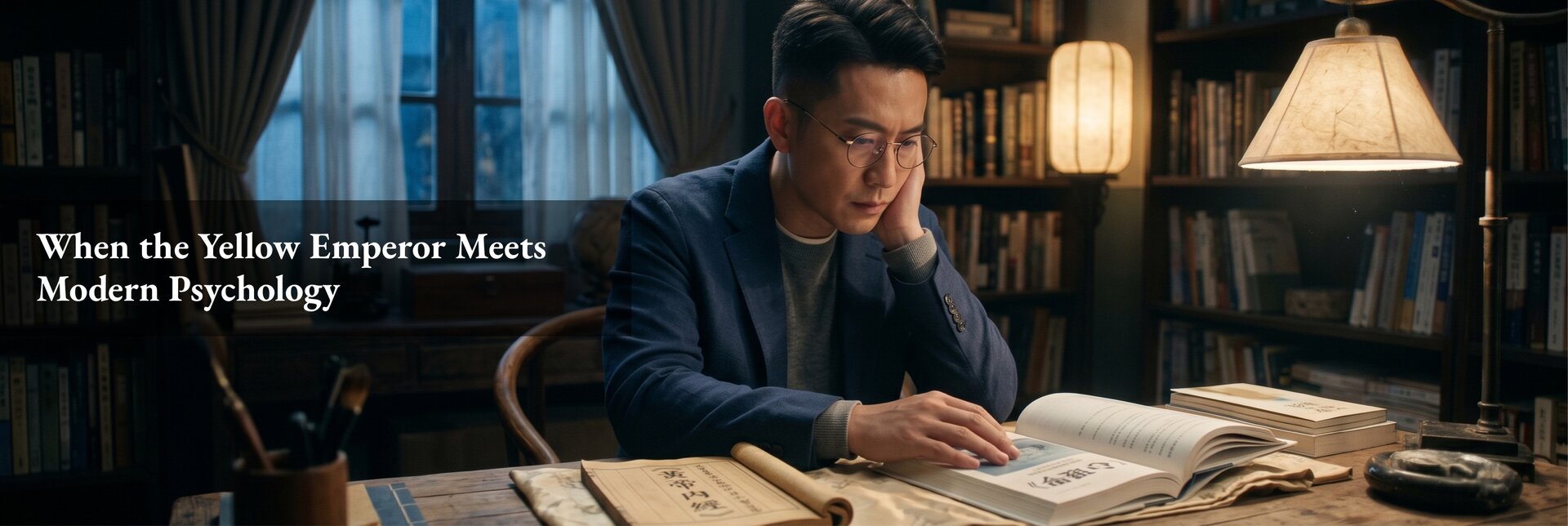
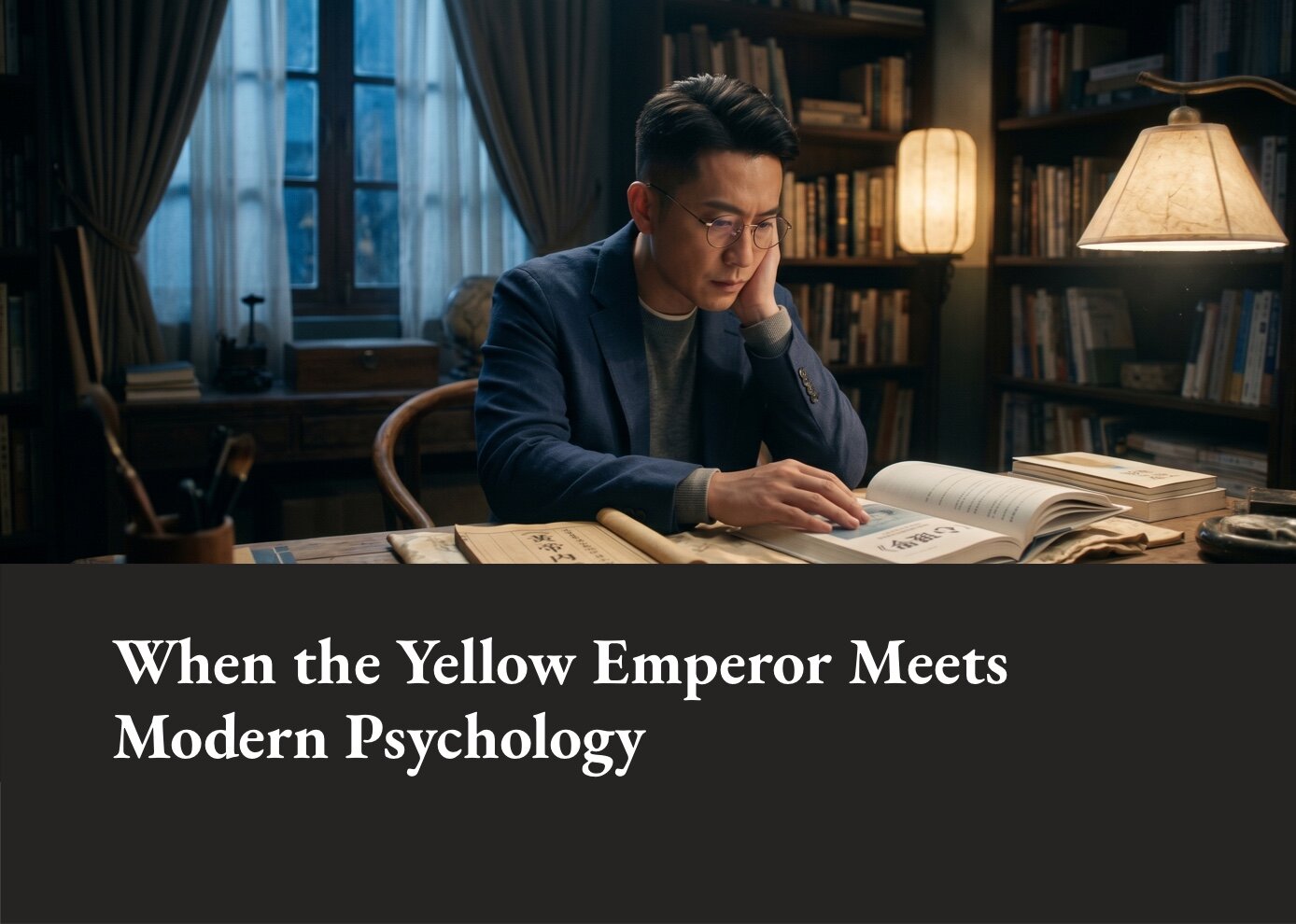
When the Yellow Emperor Meets Modern Psychology: Interactive Treatment for Insomnia
The Huangdi Neijing (The Yellow Emperor's Inner Canon) posits that the human body is an integrated whole composed of both "Form" (physical body) and "Spirit" (mind), which mutually constrain and generate one another forming a holistic whole. Proper development of the "Spirit" leads to a healthy "Physical Form,"; conversely, psychological pathology adversely affects physical health.
While ordinary doctors focus solely on the patient’s physical body, master doctors treat the patient’s spirit. This represents the ultimate shared ideal of Traditional Chinese Medicine (TCM) psychiatry and modern psychology. This article explores the core methods by which TCM practitioners seamlessly integrate psychology into clinical practice to achieve the core principle of "harmony between body and mind."
Using the interactive treatment of insomnia through TCM psychiatry and modern psychology as an example, this article discusses how to optimize the depth of observation and inquiry in the "Four Diagnostic Methods" of TCM.
1. The Yellow Emperor's Inner Classic, Ling Shu, Tian Nian (The Heavenly Lifespan)
"When blood and Qi are harmonized, the nutritive (Ying) and defensive (Wei) Qi flow freely, the five viscera organs are fully formed, the spiritual Qi (Shen Qi) resides in the Heart, and the soul and spirit are fully intact, only then is a human being truly formed."
【Interpretation】 When the body's Qi and blood are harmonized, the nutritive and defensive Qi flow smoothly, the internal organs are fully developed, the "spiritual Qi" is housed in the Heart, and the "ethereal and corporeal souls" (Spirit) are fully intact, a true "human being" is born. This indicates that a human inherently exists as a whole consisting of Body Form and Spirit, which mutually constrain and generate each other to shape an individual's entirety.
2. The Yellow Emperor's Inner Classic, Ling Shu, Ben Shen (The Roots of Spirit)
"That which comes with life is called Essence (Jing); the union of two Essences is called Spirit (Shen); that which moves back and forth with the Spirit is called the Ethereal Soul (Hun); that which exits and enters alongside the essence is called the Corporeal Soul (Po). That which takes charge of external things is called the Heart (Xin); when the Heart remembers something, it is called Intent (Yi); when Intent is retained, it is called Will (Zhi); when Will undergoes changes based on retention, it is called Thought (Si); when Thought projects far into the future, it is called Consideration (Lü); when Consideration allows one to handle external things properly, it is called Wisdom (Zhi)."
【Interpretation】 The Proper Progression of the Spirit (Leading to a Healthy Body Form):
- Spirit (Shen): The core of human vitality is the spirit (the life force generated by the union of the two Essences).
- Heart (Xin): The Heart or soul, alongside the Hun and Po, marks the beginning of mental and cognitive activities (the Heart takes charge of things).
- Intent (Yi): The ideas and memories generated after thinking constitute intent (what the Heart remembers).
- Will (Zhi): Ideas and intentions form long-term goals or memories (where intent is retained).
- Thought (Si): Repeatedly pondering over one's goals to seek change (changes based on the Will).
- Consideration (Lü): Thinking deeply to plan ahead and anticipate the future (projecting far into the future due to thought).
- Wisdom (Zhi): Ultimately finding the correct solution to a problem, manifesting as wisdom (handling external things due to consideration).
3. The Yellow Emperor's Inner Classic, Suwen - Jutong Lun (Treatise on the Evolution of Pain)
"All diseases are generated by Qi. Anger drives Qi upward; joy relaxes Qi; sadness dissipates Qi; fear drives Qi downward; fright deranges Qi; pensiveness knots Qi."
【Interpretation】 Causes of Psychological Pathology (Affecting Physical Health):
- Anger drives Qi upward: Severe anger forces Qi and blood to counterflow upward, sharply reducing liver blood flow (leading to hypertension, stroke).
- Joy relaxes Qi: Excessive excitement scatters Heart-Qi, making concentration impossible.
- Sadness dissipates Qi: Extreme grief consumes Lung-Qi, leading to despondency and decreased immunity.
- Fear drives Qi downward: Fear causes Kidney-Qi to become insecure (e.g., incontinence from being terrified).
- Fright deranges Qi: Sudden fright throws the mind into chaos, causing chaotic Qi and blood flow (e.g., palpitations).
- Pensiveness knots Qi: Internal exhaustion from anxiety and overthinking causes Qi mechanisms to stagnate in the Spleen and Stomach (leading to indigestion, loss of appetite).
4. The Yellow Emperor's Inner Classic Suwen - Xuanming Wuqi (The Manifestations of the Five Qi)
"What the five viscera-organs stores: The Heart stores the Spirit (Shen), the Lungs store the Corporeal Soul (Po), the Liver stores the Ethereal Soul (Hun), the Spleen stores the Intent (Yi), and the Kidneys store the Will (Zhi)."
【Interpretation】 TCM psychiatry provides extremely meticulous definitions and evolutionary processes regarding these five internal organs and their respective spiritual dimensions.
5. The Yellow Emperor's Inner Classic Suwen - Yinyang Yingxiang Da Lun (Great Treatise on the Resemblance of Yin and Yang to Phenomena)
"Anger injures the Liver, but sadness overcomes anger. Joy injures the Heart, but fear overcomes joy. Pensiveness injures the Spleen, but anger overcomes pensiveness. Melancholy injures the Lungs, but joy overcomes melancholy. Fear injures the Kidneys, but pensiveness overcomes fear."
【Interpretation】 Utilizing the principle of the Five Elements' mutual restriction, the Yellow Emperor proposes "Emotional Counteraction Therapy" (e.g., using sadness to overcome rage, fear to overcome joy, anger to overcome overthinking, joy to overcome melancholy, and overthinking to overcome fear). Modern emotional therapies in psychology share an identical concept.
TCM Psychiatry Approach
The core principle of treating insomnia in TCM psychiatry is "First calm the Heart, then close the eyes."
- The "Heart" refers to the spirit, emotions, and thoughts (as TCM dictates, "the Heart stores the Spirit").
- The "Eyes" represent the physical state of sleep.
To achieve sound physical sleep, one must first pacify the inner mind and thoughts. TCM believes the fundamental pathogenesis of insomnia is "Yang failing to enter Yin, and the Heart-Spirit being disturbed." When psychological stress and dysregulation of the Seven Emotions (anger, joy, worry, grief, fear, and fright) occur, it directly scrambles the body's Qi mechanisms and disrupts organ functions, thereby unsettling the Heart-Spirit.
TCM psychiatry manages insomnia through the psychological theory of "Emotional Counteraction Therapy," which utilizes one emotion to correct another based on the Five Elements' mutual restriction (e.g., "sadness overcomes anger," "pensiveness overcomes fear," "fear overcomes joy").
Modern Psychology Approach
Modern psychologists primary tackle insomnia via Cognitive Behavioural Therapy for Insomnia (CBT-I)—a non-pharmacological, evidence-based clinical approach.
The treatment principle revolves around correcting distorted beliefs about sleep and breaking the brain's anxious association between the bed and sleeplessness. This fundamentally reshapes the brain's sleep reflex mechanisms.
Integrated Treatment Protocols for Insomnia: TCM Differentiation & Modern Clinical Practice
1. Liver Qi Stagnation Transforming into Fire (Insomnia due to Flaring Liver Fire)
- Symptoms: Insomnia, irritability, and easy to anger; lack of appetite, thirst with a desire to drink, red eyes, bitter taste in the mouth, dark yellow urine, constipation. Red tongue with a yellow coating, string-like (Xian) and rapid (Shu) pulse.
- Treatment Principle: Soothe the Liver and clear heat, assisted by calming the spirit.
- Herbal Formula: Longdan Xiegan Tang combined with Suanzaoren Tang龍胆瀉肝,酸棗仁湯.
- TCM Psychiatry: Inquiry diagnostic method utilizes the "Emotional Counteraction Therapy" based on the Five Elements' restriction principle: "Anger injures the Liver, but sadness counteracts anger—is a method of emotional balance."
Modern Psychological Theory: Humanism and Emotional Catharsis.
Modern Psychological Prescription: Utilizing humanistic listening and empathy techniques to guide the patient to voice suppressed anger and openly vent negative emotions. Catharsis clears the obstacles to self-interpretation, allowing the individual to see their inner needs clearly and reboot the process of self-actualization.
2. Deficiency of both Heart and Spleen (Caused by Overthinking)
- Symptoms: Excessive dreaming and waking up easily, palpitations, forgetfulness, dizziness, fatigue and mental exhaustion, tastelessness in eating, dull complexion. Pale tongue with a thin coating, thready (Xi) and weak (Ruo) pulse.
- Treatment Principle: Tonify and nourish the Heart and Spleen to generate Qi and blood.
- Herbal Formula: Guipi Tang or Yangxin Tang.
- TCM Psychiatry Insight: Excessive pensiveness injures the Spleen. A deficient Spleen leaves Qi and blood with no source for transformation. Blood deficiency fails to nourish the Heart-Spirit ("the Heart stores the Spirit"), leading to the "Spirit failing to remain in its abode," which manifests as nighttime insomnia or vivid dreaming with easy awakening.
Modern Psychological Theory: Cognitive Behavioural Therapy for Insomnia (CBT-I).
Modern Psychological Prescription:
- Stimulus Control Therapy
- Sleep Restriction Therapy
- Cognitive Restructuring
- Relaxation Training
- Sleep Hygiene Education
Note: CBT-I acts like a behavioural version of the Yellow Emperor's health preservation (Yang Sheng) methods. By shifting cognition, it halts "internal friction" and ensures the "Spirit is guarded within." Consequently, the Spleen and Stomach can digest smoothly, and the Heart-Spirit naturally settles into a peaceful sleep.
3. Heart and Kidney Disharmony Type (Sleepless Nights Driven by Anxiety and Fear)
- Symptoms: Deficiency of Kidney-Yin with hyperactive Heart-Fire; failure of water and fire to balance. Restlessness and insomnia, palpitations, night sweats, depletion of Kidney essence leading to an empty sea of marrow, dizziness, tinnitus, forgetfulness. Red tongue, thready (Xi) and rapid (Shu) pulse.
- Treatment Principle: Nourish Yin and subdue Fire, re-establish communication between the Heart and Kidneys.
- Herbal Formula: Huanglian Ejiao Tang, Xinxian Liangjiao Tang, or Jiaotai Wan. 黃蓮阿胶湯,心腎兩交湯,交泰丸
- TCM Psychiatry Insight: The Heart belongs to Fire (positioned above), and the Kidneys belong to Water (positioned below). Kidney-Water must ascend to moisten Heart-Fire, while Heart-Fire must descend to warm Kidney-Water.
- Pathogenesis: Excessive sexual activity, staying up late, or aging depletes Kidney-Yin. Kidney-Water fails to ascend to assist Heart-Fire, leaving Heart-Fire to flare up excessively on its own (lack of communication between Heart and Kidney), resulting in internal heat, dysphoria, and insomnia.
Modern Psychological Theory: Combining Psychology (Mindfulness, Mindfulness-Based Stress Reduction (MBSR) and Mindfulness Body Scan.
Modern Psychological Prescription: Apply MBSR techniques. Instruct the patient to perform a "Body Scan" before sleep. Through focused awareness, the patient guides the over-excited Yang Qi floating in the head (an overheated brain, which equates to Heart-Fire) downward toward the Kidneys. This achieves the TCM state of "drawing fire back to its source, and intertwining Yin and Yang"
Using the interactive treatment of insomnia by traditional Chinese medicine psychiatry and modern psychology as an example, other mental health issues such as forgetfulness, depression, and mania can also be explored and addressed through mutual strength to help patients recover as quickly as possible.
All articles/videos are prohibited from reproducing without the permission of the copyright holder.
SHARE THIS




 Thank you for your like.
You’ve liked this article. Please browse more articles you may like!
people have liked this article/video
Thank you for your like.
You’ve liked this article. Please browse more articles you may like!
people have liked this article/video
Welcome to leave a message:
Please Sign In/Sign Up as a member and leave a message