Exploring Wufeng Lin Family’s Residences:
A Glimpse into Traditional Chinese Culture
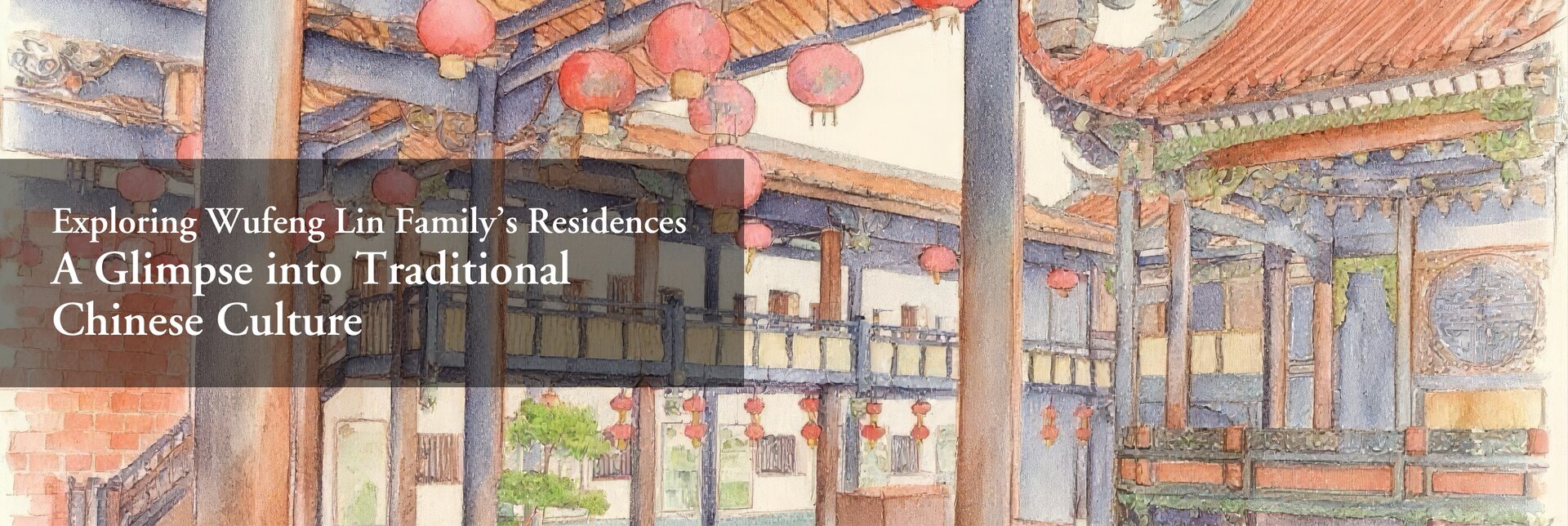
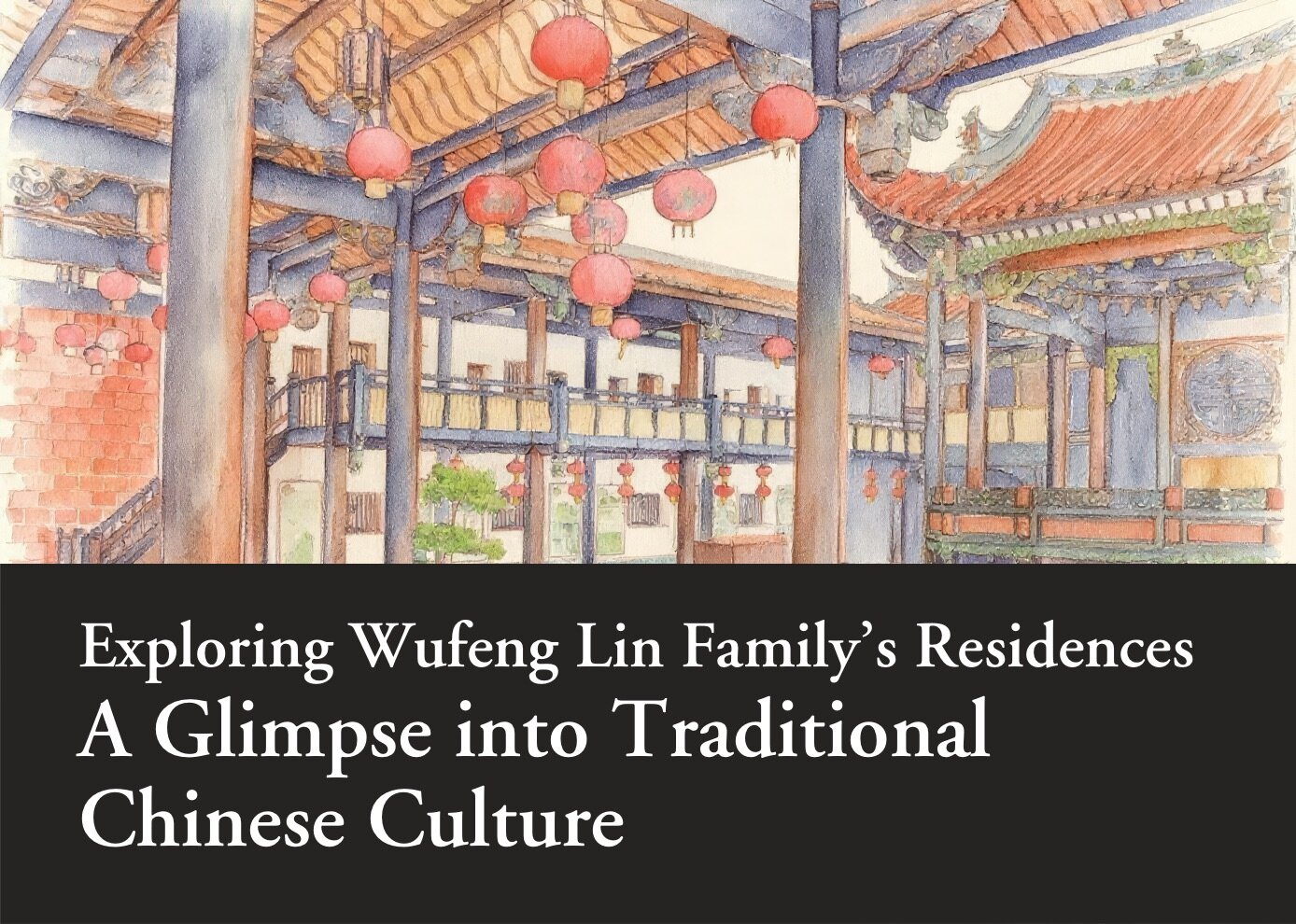
When browsing general knowledge materials, the so-called ‘Five Great Families of Taiwan’ are often spotlighted in the context of the Japanese occupation period (1895-1945). Wikipedia launches the topic this way, and many historians also situate their discussions in that era. However, the rise of these five families followed different trajectories, each with its ties to national identity and Chinese culture. Among them, the Lin family of Wufeng stands out in particular. Take their residences, for instance — Professor Lee Chien-Lang, an authority on architectural heritage, praised the Wufeng Lin residences as an encyclopedia of traditional Taiwanese architecture. I recently paid a brief visit to their ancestral grounds and made some initial appreciations to their three main buildings.
Lin family rose to prominence during the mid-to-late Qing dynasty, flourished particularly under Lin Wencha, the third generation after settled in Wufeng. He distinguished himself in putting down the Taiping Rebellion, and was posthumously awarded the title of ‘Junior Guardian to the Crown Prince’ after dying in battle at Wansong Pass. His mansion earned the honorary title of ‘Gongbaodi,’ the only one of its kind in Taiwan. The mansion, with its five courtyards and eleven partitions, remains the largest extant Qing official residence in Taiwan. A highlight of Gongbaodi is its ‘Grand Flower Hall’ with a theater — featuring a Fuzhou-style design and signature curved roof — where an octagonal coffered ceiling is carved with a peony, known as ‘the king of flowers’, hence the name. These Fuzhou architectural elements are rare survivals in Taiwan. (Wang Dulu of Chiayi, also prominent in the Jiaqing and Daoguang reigns, was similarly honored as ‘Guardian to the Crown Prince’, but his mansion no longer exists.)
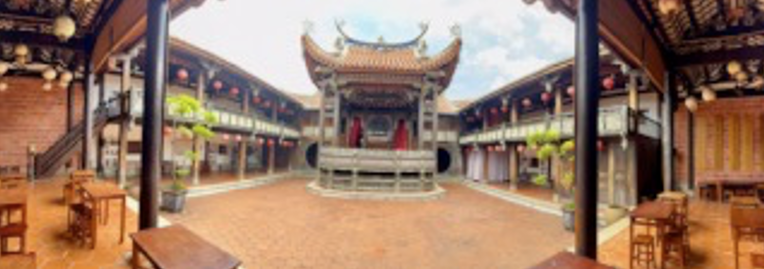
By Lin Wencha’s time, the Lin family had already been in Taiwan for five generations (more than a century) since emigrating from Zhangzhou, Fujian, yet their ties to their ancestral homeland remained deep and unbroken. Lin Wencha, who rose to the top rank of Admiral of Fujian’s land and naval forces, died in battle in Zhangzhou. In the Guangxu reign, the family amassed wealth through the camphor trade, obtaining a monopoly license from the Qing court for the whole Fujian province (Taiwan became a province from the 11th year of the Guangxu reign, and the monopoly rights in Taiwan also belonged to the Lin family). Lin Wencha’s son, Chaodong, proved himself a true military heir — he repelled the French during the Sino-French War and later headed the Taiwan Development Bureau after Taiwan became a province. The ‘Grand Flower Hall’ served as a venue for official meetings and banquets during the peak of Taiwan capital city’s influence.
After the First Sino-Japanese War, when Japan occupied Taiwan, Lin Chaodong sent his family to Xiamen for safety and returned to Taiwan alone to resist. After his death, he was buried in Zhangzhou. His son, Lin Zumi, supported Sun Yat-sen’s revolution and rose to the rank of Major General, serving as Commander of the “Southern Fujian Army.” Gongbaodi once served as the army’s command headquarters. Lin Zumi was eventually assassinated in Zhangzhou. A plaque inscribed by Ma Ying-Jeou titled ‘Three Generations of National Heroes,’ still hangs in Gongbaodi — an honor the family well deserved.
When visiting the hometown of the Lin family, you certainly can’t miss the ‘Lai Garden’. The ‘Ten Scenes of Lai Garden’ are worth taking a closer look and deeper thought at, such as the Xijia Pavilion named after Tao Yuanming’s poem ‘The mountain air is beautiful at dusk, and the returning birds are flying back together’; ‘Twelve Wonders of Taichung’ are certainly romantic, and today you may still be lucky enough to enjoy the ‘Lai Garden after the Rain’. Lin Wencha’s cousin Lin Wenqin was very filial to his mother. After passing the imperial examination in the 19th year of Guangxu reign, he built the ‘Lai Garden’ for his mother, Madame Luo, to spend her old age. The ‘Buchan Pavilion’ in the garden is a two-story building with a swallowtail pattern in southern Fujian. The upper floor is Madame Luo’s living place. ‘Buchan’ not only refers to the beautiful scenery of walking in the moonlight in the garden, but also refers to the Tang Dynasty’s story of removing the laurel from the Moon Palace to pass the imperial examination.
Wenqin’s eldest son, Lin Xiantang, inherited the family business at the age of 19. When he was only 14 years old, he followed Madame Luo’s order and led dozens of family members back to Fujian to avoid the disaster of the Japanese occupation in 1895. He received traditional Chinese education through home schooling since he was a child and grew up in ‘Lai Garden’. The "Buchan Pavilion" was rebuilt into the ‘Wugui Tower’, and the roof continued to use the traditional hard-roof style; the old theater facing the front was changed to be a pavilion, taking the allusion of Li Bai's ‘flying wine cup and getting drunk under the moon’.
In the history of Taiwan’s anti-Japanese resistance, Lin Xiantang is a nationalist categorized as one from the ‘Motherland Faction’. He was a crucial social leader of non-violent democratic resistance against Japanese occupation, enduring humiliation and political pressure with unwavering resolve. His strategies were inspired by the great intellectual Liang Qichao, who had fled abroad after the failure of ‘The Hundred-Days’ Reform’. In 1911, Liang visited Taiwan and was hosted at ‘Lai Garden’ for five days by Lin Xiantang, composing twelve poems before leaving. Famous lines like ‘Lai Garden captures a third of the moonlight’ and ‘Tears stain the kapok bridge’ express the shared sorrow of two patriots who had lost their homeland.
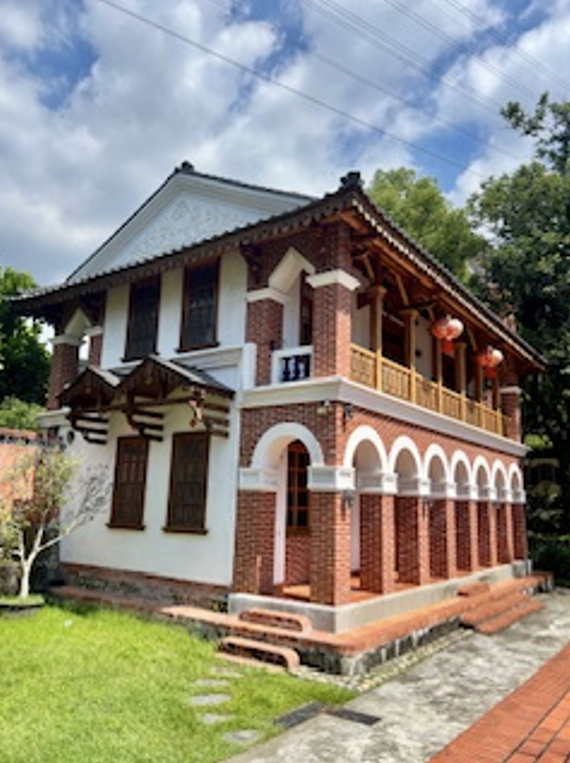
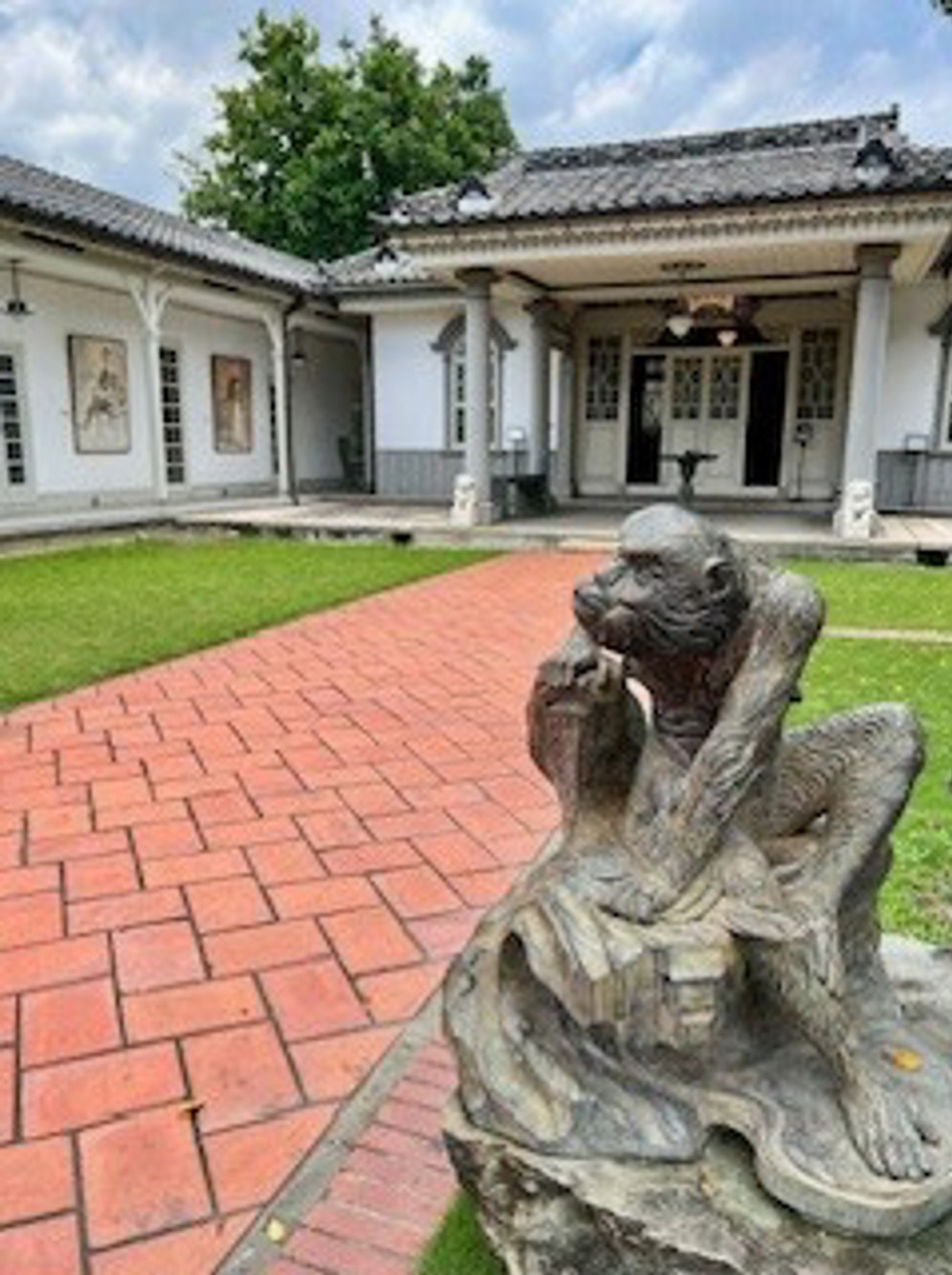
Xiantang’s eldest brother, Lin Jitang, was less politically inclined and more devoted to arts and culture. However, the construction of his ‘Yi Garden’ reflects great attention to detail and design. Built during the peak of Japanese occupation period, even elite families like the Lins could not avoid showcasing Japanese elements, such as the sculpture ‘Old Ape’ by Takamura Kōun in the middle of the front yard. Nonetheless, the courtyard followed a traditional three-sided layout, with flanking halls aligned with irrigation channels that curve and meet before the main entrance — a fengshui arrangement meant to gather energy and wealth. Guarding the wall and rooftops of the mansions are still traditional Chinese spirit creatures and auspicious beasts. At the entrance to the ‘Yi Garden Art Museum’ hangs a plaque reading ‘Spring Radiance of the Maritime Country,’ a calligraphy gift from Duan Qirui, the interim President of the Republican China, honoring Madame Zhuang of the Lin family for her birthday. These design choices reflect the Lin family’s deep-rooted sentiments for Chinese cultural identity.
In 1999, the Jiji Earthquake struck Taiwan, causing severe damage to the Lin family buildings. Whether and how to restore them sparked intense debate among officials, scholars, the public, and Lin family members. Fortunately, a consensus was eventually reached. With contributions from numerous experts, these structures now stand again, such as the collapsed Grand Flower Hall and Wugui Tower were rebuilt using cypress in place of Taiwan incense cedar, restoring the century-long grandeur of Chinese cultural heritage.
Law Kam-yee is Associate Professor in the Department of Social Sciences and Policy Studies at the Education University of Hong Kong. He is also the Commissioning Editor of ‘East Asia Focus’ series published by the City University of Hong Kong Press and ‘Belt & Road Initiative and Asia’ series published by Chung Hwa Books Co., and Advisor of Society of Transcultural Studies.
References
1.吳文星(2014):〈日治時期台灣五大家族的發展與互動〉,《台灣學通訊》,第80期,頁30。
2.司馬嘯青(2000):《台灣五大家族》,台北:玉山社。
3.若林正丈(2020):《台灣近代抗日運動史研究》,新北:大家出版社。
4.林德俊(2018):《霧繞罩峰:阿罩霧的時光綠廊》,台北:遠景出版社。
All articles/videos are prohibited from reproducing without the permission of the copyright holder.
SHARE THIS




 Thank you for your like.
You’ve liked this article. Please browse more articles you may like!
people have liked this article/video
Thank you for your like.
You’ve liked this article. Please browse more articles you may like!
people have liked this article/video
Welcome to leave a message:
Please Sign In/Sign Up as a member and leave a message