

The Gate of Confucius's Father
There is a story in "The Complete Tale of Tang (《說唐全傳》)" that goes as follows:
It is said that toward the end of the Sui Dynasty (隋朝,581-618), heroes and warriors arose one after another across the land, giving rise to what was known as the "eighteen rebel kings (十八路反王)." Emperor Yang of Sui (隋煬帝,569-618) made every effort to bring them to submission, setting up a martial arts arena in Yangzhou (揚州), where the victor would be granted a royal title. In truth, this was nothing but a trap laid by Emperor Yang — he intended to let the heroes slaughter one another, while explosives buried underground would finish off whoever remained; should any survivors still be standing, a thousand-catty portcullis would be dropped at the city gate, and the imperial guards would move in for the kill. As fate would have it, an old fox had dampened the explosives, preventing them from detonating. So the original plan proceeded: the thousand-catty portcullis was lowered from the city wall. The Book describes the scene as follows:
The kings all sensed that something was amiss and guarded against unforeseen danger. They mounted their horses all at once and rode like the wind toward the city gate. Suddenly a cannon shot rang out, and the thousand-catty portcullis came crashing down from above. Xiong Kuohai (雄闊海) had just arrived at the city gate when he saw the portcullis descending, and he quickly dismounted and caught it with both arms, letting out a great cry. The kings called back: "There is treachery within the city!" Xiong Kuohai shouted: "Since there is treachery, those of you who wish to leave the city — make haste while I hold up this thousand-catty portcullis! Go quickly!" The princes of the eighteen kingdoms and warriors from every direction surged out through the gate together, and every last one of them escaped. Xiong Kuohai had been running for a day and a night, his belly empty and his body exhausted, and on top of that he had been holding up the thousand-catty portcullis for half a day while those above kept pushing down on it with all their might. His hands above his head gave way, and with a thunderous crash, he was crushed to death beneath the gate (衆王都有些知覺,防有不測之變,一齊上馬,飛的一般俱奔到城下。忽聽一聲炮響,城上放下千斤閘來。那雄闊海剛剛來到城門口,只見上邊放下閘來,忙下馬一手抱住,大叫一聲。衆王應道:「城內有變!」雄闊海道:「既然有變,你等要出城者,趁我托住千斤閘在此,快走!」那十八家王子與各路烟塵一起爭出城來,一個個都走脫了。雄闊海走了一日一夜,肚子饑餓,身子已乏,跑到就托了半日千斤閘,上邊又有許多人狠命的推下來,他頭上手一松,「撲撻」一響,壓死在城下).1
This passage, merely a few hundred words long, left me wanting more when I first read it; yet the fate of Xiong Kuohai moved no small number of readers to sighs. Among them, one person was influenced most profoundly of all — none other than the later-celebrated Lu Xun. (魯迅,1881-1936).
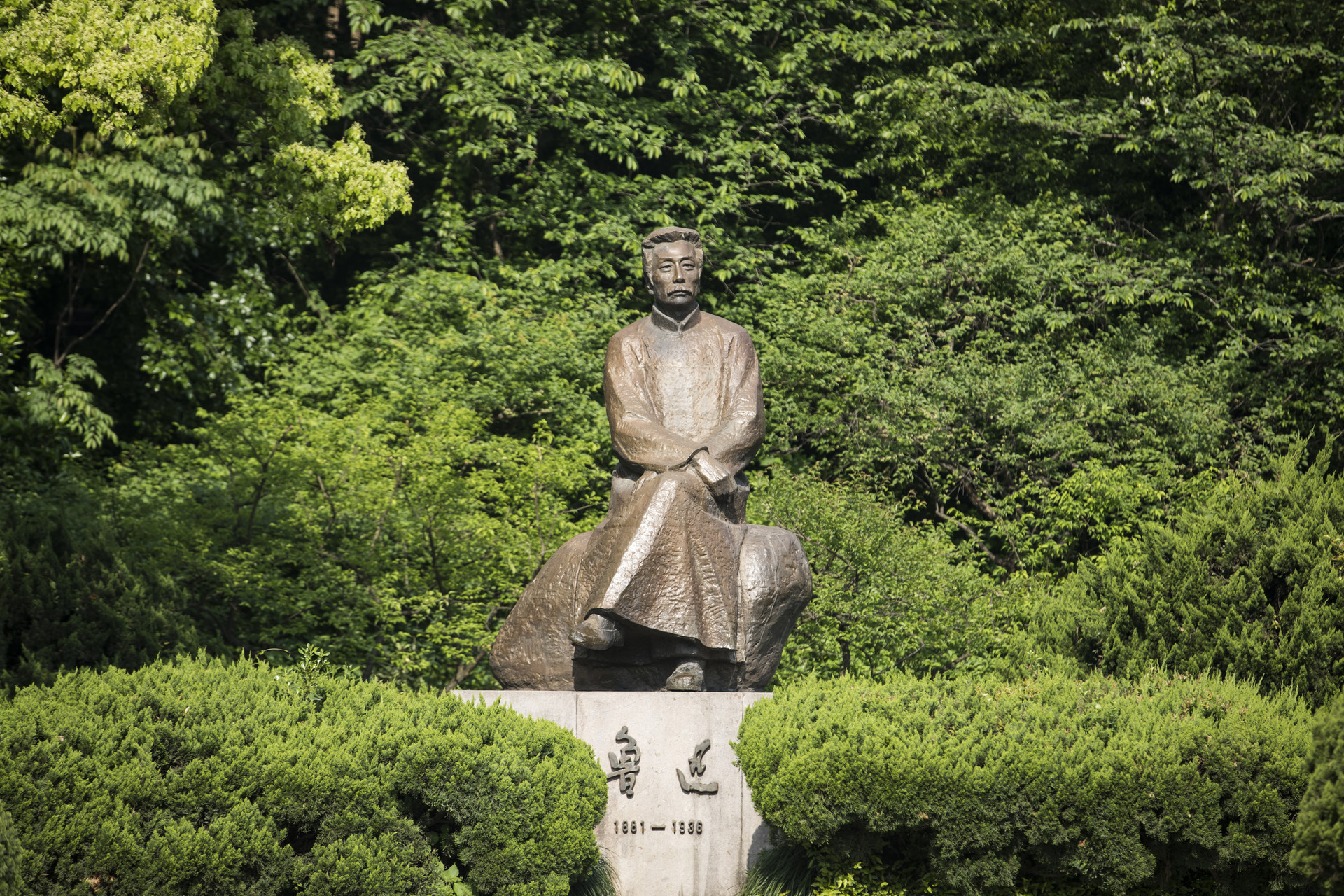
Five months after the May Fourth Movement (五四運動) of 1919, Lu Xun wrote an essay titled "How We Are Fathers Today (〈我們現在怎樣做父親〉)," in which he said:
Bearing the burden of inherited tradition on our own backs, we hold up the dark gate with our shoulders, letting them (the children) pass through to a place of openness and light; so that henceforth they may live in happiness and conduct themselves as reasonable human beings (自己背著因襲的重擔,肩住了黑暗的閘門,放他們(孩子們)到寛闊光明的地方去;此後幸福的度日,合理的做人).2
Earlier, in 1918, Lu Xun had published his first vernacular short story, "Diary of a Madman (〈狂人日記〉)," in Volume 4, Issue 5 of "La Jeunesse (《新青年》)", ending with the cry "Save the children (救救孩子)."3Both this cry and the essay on "How We Are Fathers Today" trace their origins to the gate in "The Complete Tale of Tang." Traditional vernacular novels such as "The Complete Tale of Tang" had a profound influence on Lu Xun. In the 1960s, Hsia Tsi-an (夏濟安,1916-1965) conducted research in the United States on China's left-wing literary movement, covering writers including Lu Xun, Jiang Guangci (蔣光慈,1901-1931), the Five Martyrs of the League of Left-Wing Writers (左聯五烈士)4, and Qu Qiubai (瞿秋白,1899-1935). In 1968, after Hsia's sudden death, the English edition was published posthumously under the title "The Gate of Darkness"5— the word "Gate" being drawn directly from "The Complete Tale of Tang."
In fact, the "prototype" of that "Gate" did not originate from "The Complete Tale of Tang", but from Shuliang He (叔梁紇,623-549BC), the father of Confucius (孔子,551-479BC). "The Complete Tale of Tang" is said to have been in circulation during the Yongzheng reign of the Qing dynasty (清代雍正年間,1722-1735); its author is unknown and numerous editions exist. Shuliang He, given name He (紇), courtesy name Shuliang (叔梁),6 did not father Confucius until he was nearly seventy, and died when Confucius was only three. According to the "Commentary of Zuo (《左傳》)," the allied forces of the Jin state (晉國,11th century BC–369 BC)'s vassals besieged the state of Bi Yang (逼陽, Now within the territory of Tai'erzhuang District, Zaozhuang City, Shandong Province) but could not take it. Qin Jinfu (秦堇父), a retainer of the Mengsun clan (孟孫氏), had supply wagon hauled by manpower to the battlefield. The people of Bi Yang opened their city gates, and the allied soldiers seized the opportunity to rush in — whereupon the defenders suddenly dropped the portcullis, intending to trap them like turtles in a jar. At this critical moment, Shuliang He braced the gate with both hands, allowing those who had entered to escape. This episode is virtually identical to the story of Xiong Kuohai in "The Complete Tale of Tang." Xiong Kuohai is a fictional character, and the inspiration for him was almost certainly drawn from Shuliang He's feat of lifting the gate. Shuliang He was a renowned warrior of the state of Lu (魯國,11th century BC–256 BC) at the time, serving in the allied forces — courageous and skilled in battle, standing over nine chi (尺) tall, broad-shouldered and powerfully built. After letting the men escape, he lowered the gate and fled himself, and was not crushed to death as Xiong Kuohai was. Both men are towering heroic figures. Confucius inherited his father's physical constitution and likewise stood over nine chi tall, earning him the epithet "the tall man (長人)" in his time. The The "Master Lü's Spring and Autumn Annals (《呂氏春秋》)," in the chapter "Prudence in Greatness (慎大)," records: "Confucius was strong enough to lift the bar of a capital city's gate, yet he had no desire to be known for his physical prowess (孔子之勁,舉國門之關,而不肯以力聞)."7 Confucius's exceptional strength was indeed inherited from his father.
The irony is that Lu Xun — that champion of "anti-Confucian ethics" — drew upon the story of "lifting the gate by brute strength (力舉閘門)" from "The Complete Tale of Tang." One wonders whether he ever knew that the prototype of that story came from the father of Confucius himself.
Reference
1. 鴛湖漁叟 校訂:《說唐全書》(上海:上海古籍出版社,2004),頁324。
2. 唐俟(魯迅):〈我們現在怎樣做父親〉,《新青年》第六卷第6號(1919)。另見 《新青年(第六卷)》(北京:中國書店,2011),頁491。
3. 魯迅:〈狂人日記〉,《新青年》第四卷第5號(1918)。 此文後收入《吶喊》一書。另見 《新青年(第四卷)》(北京:中國書店,2011),頁323。
4. The Five Martyrs refers to five revolutionary writers associated with the League of Left-Wing Writers (中國左翼作家聯盟) who were secretly executed by the Nationalist government on February 7, 1931. They were Hu Yepin (胡也頻,1903-1931), Rou Shi (柔石,1902-1931), Feng Keng (馮鏗,1907-1931), Yin Fu (殷夫,1910-1931), and Li Weisen (李偉森,1903-1931).
5. 中譯本見 王宏志 主編:《黑暗的閘門:中國左翼文學運動研究》(香港:香港中文大學出版社,2016)。
6. 原文:「孔子之父名紇,字叔梁。古人名字幷言者,皆先字而後名。故《史記·孔子世家》稱爲叔梁紇也。」見 左丘明 傳;杜預 注; 孔穎達 正義;浦衛忠 等 整理:《春秋左傳正義》(北京:北京大學出版社,2000),頁135。
7. 呂不韋:《呂氏春秋》(上海:上海古籍出版社,1989),頁117。
All articles/videos are prohibited from reproducing without the permission of the copyright holder.
SHARE THIS




 Thank you for your like.
You’ve liked this article. Please browse more articles you may like!
people have liked this article/video
Thank you for your like.
You’ve liked this article. Please browse more articles you may like!
people have liked this article/video
Welcome to leave a message:
Please Sign In/Sign Up as a member and leave a message